World Class Safety Metrics

In this journey to better understand world-class safety, I feel there has to be some talk of metrics. Being perfectly honest, I have an extreme love-hate relationship with safety data. I am never in between. I either love what they are showing me or I hate the entire idea of tracking it at all. Hopefully, I can explain why my relationship with safety data is full of turmoil

First thing first, though. I am going to use the lean term “process indicator” as a synonym of safety metrics. Safety metrics are only an indication of how well your culture, systems, and processes are working to protect your team. As we explore how metrics are integrated into a world-class safety system, this is a key definition.

1) Reactive safety data is pretty much worthless.
Incident rates, lost time rates, days away and restricted rates, first aid rates all are measuring something that really should not be measured. Yes, we have to for OSHA. But even in the inception of the recordkeeping standard, this was not meant as a good/bad indicator. These numbers and measures were not meant to be how a company benchmarks itself. Any number, even zero, is not world-class (more on that later). The intention of recordkeeping was to help companies identify problem areas and find solutions. Each metrics that we measure reactively is a person who is changed for the worse because of their involvement at the workplace. As with previous entries, we are seeking to prevent harm. We are not seeking an arbitrary number based on others’ experiences.

2) We are not driving to zero
Reaching a number is a goal. A safety culture is not a destination. It is a journey of continuous improvement. Unfortunately, some companies reach zero, assume they are done, and then have a catastrophic event. They assumed they reached the goal, won the race, and wiped their hands clean of safety. This is not to mention how many companies play the numbers game to avoid or simply not report injuries. These numbers are practically fiction. So, having leadership that shouts and demands that they want zero injuries without investment, energy, and strategy are simply enjoying the sound of their own voice.

3) Culture is not an overnight journey
Here is where I love safety metrics. We have to collect the data anyway, how do we make it work for us rather than against us. My career has taken me around to various startups and turnarounds. Going into these situations, there are tons of opportunities for driving improvement. Using proper statistics, I have been able to show year-over-year improvement and correlate those improvements to the programs. The data helps to see the path. Data shows where the systems are working and what needs to be adjusted. It is a process indicator. If we are looking for hazards to correct and the numbers are dropping is that because we are better or because a system is broken. We had an increase in near-miss reports and a decline in safety work orders, why? The data is simply showing us where we should invest time to better understand where we can improve. We must not lose sight that improvement means we are lessening human harm. Not everyone is a data person and that is okay. There is probably someone in your organization that loves data. Give them a chat and see what correlations they can help you find. Always remember, though, correlation is not causation. You still will need to verify the truth in the data

4) Get appropriately lean
Yes, I am one of those that loves lean and six sigma. I am admittedly a novice and have much to learn. I still love it. Just like any tool, it has to be used in the right situation. There are those that have taken all the lean tools and made everyone use them all the time without understanding if that is the tool for the job. Andons everywhere. Gemba walks hourly. Fishbone analysis. On and on. The approach I have used that works best is the simple one. Review the data, Gemba (go to the place) where the data leads, observe the people doing the work, see if it matches the expected standard, adjust accordingly. Sometimes these walks are to solve a problem. Sometimes they are to see a best practice. Sometimes they are to verify if the data is correlating correctly. Each of these situations lead to adjustments and create improvement all with the goal of protecting our team.

TL;DR: If you data is not helping prevent harm to your team, it is worthless.
World Class Begins with Attitude

This year, I am dedicating my blog posts to exploring what is world-class in safety. As I we closed 2019, the discussion was about how some organizations like to throw the term “world-class” around when it comes to safety. They use the term as a part of marketing safety without really thinking about what it means to be best in class for protecting their people. For some, it means compliance with the law. For others, it might mean having lunches when there are no injuries for a month. When it really gets down to the real meaning of world-class, it begins with having a world-class attitude toward safety.

There is much debate about world-class safety. Does it exist? Is it measurable? Are there metrics? How is it performed? Can we compare it to other companies? Honestly, those are good questions. Honestly, I am not sure there is a right answer. I do think that there are principles that an organization can develop to create a world-class safety attitude. Before any of the metrics or processes can really be evaluated, there first has to be the right mindset. There has to be the overall compass directing the efforts and organization to the path of world-class. So, here are my five principles of world-class safety.

1. It means we care enough to focus on reducing and eliminating harm

Measuring all the injury and first aid rates does not compare to actually looking at your team as people and realizing that their pain is bad for business. There are too many stories of the zero injury companies that have a large incident. We are not chasing a zero incident rate. We are driving for solutions that prevent people from hurting for doing their job. Yes, seeking no harm will affect an incident rate. But it is not the incident rate that is the goal. We have to learn from every incident, adapt based on near misses, and improve through observation.

2. It means there are no boundaries for protecting our team

A 1987 speech from Paul O’Neill as he took the helm of Alcoa summarizes this best (Full Story Link)

“I want to talk to you about worker safety. Every year, numerous Alcoa workers are injured so badly that they miss a day of work. Our safety record is better than the general workforce, especially considering that our employees work with metals that are 1500 degrees and we have machines that can rip a man’s arm off. But it’s not good enough. I intend to make Alcoa the safest company in America. I intend to go for zero injuries”.

A shareholder asks about inventories in the aerospace division. Another asks about the company’s capital ratios.

“I’m not certain you heard me. If you want to understand how Alcoa is doing, you need to look at our workplace safety figures. If we bring our injury rates down, it won’t be because of cheerleading or the nonsense you sometimes hear from other CEOs. It will be because the individuals at this company have agreed to become part of something important: They’ve devoted themselves to creating a habit of excellence. Safety will be an indicator that we’re making progress in changing our habits across the entire institution. That’s how we should be judged”

If there is a solution to prevent harm to our team, we must drive relentlessly to complete it.

3. It means our people are our most valuable asset and resource

Too many companies have trouble believing that if you really care and protect your people, they will protect the company. It is a lean mentality idea. Use a good process, give it time to work, use the results to course correct the path. A good process will yield a good result. We too wrapped up in seeing immediate impacts and results. These short-term, micro-managing, profit first processes get in the way of world-class in more ways than just safety.

4. It means we will communicate openly about safety

This loosely ties to the first principle. We cannot shut down communication because we reached the goal of zero. We cannot quit driving to find other hazards to eliminate, listening to the team concerns, or seeking improvement because it has been a year since the last lost-time injury. The organization must be open and available for dynamic and honest two-way communication. If there is a hazard, it needs to be communicated and fixed. If there is a better way or new technology, it should be evaluated to see if or how it might work. If someone claims that having too many Pepsi machines and not enough Coke is a safety issue, we need to be able to say no. It is about sharing the message and keeping the team going the right direction.

5. It means the safety culture is indistinguishable from the company culture

This is where world-class begins

Culture Cannot Exist without the People

When someone says safety culture, what comes to mind?

Methods?

Systems?

Behaviors?

People?

Standardization?

I was recently at a conference with some peers and a great discussion started about global, organizational culture. I do have to note, I loved the way they talked about their company culture, not just safety culture. Safety was conveyed as an integral piece of the overall culture. In other words, they had no company culture without safety. 

The discussion was focused around creating a system that would create a company culture for their global network. Also, the company had been around for decades. So, they were a highly diverse company. They wanted everyone to use the basic tools, principles, and essentially speak the same cultural language of their company. The basic idea was to take that amazing diversity and create a single culture that could function in synchrony. Their goal was not to take away from the diversity but to use it to sculpt what would become the organizational culture. 

This is what got me to think more about culture across this scale. Can there be nuances of culture (specifically for me the safety component)?

Safety culture is like any other cultural component. It can be based on so many people based factors: location, age, education, and so many more. From the creation of a safety culture standpoint, this is where I feel we fail as companies. The company is driven by a laser focus on lean mentality to standardize. So much so sometimes that the tools and processes are forcefully integrated into the culture. They forget that lean is about having tools to eliminate waste and using the right tool for the right process. The local culture is not a waste. It is something that needs the right tool to be applied. 

Here is a rough example. The idea of peer-to-peer observations has always been a tremulous path. So often, it is not used or implemented in a way that reaches its full potential. If a culture of the location or region is one that does not bode well to that type of interaction, why force it? There are other observation and hazard recognition tools available that can be just as effective.

I love the story of a very dynamic supervisor I worked with. He was amazing. He loved uplifting his people. He was very handshake, high-five, pats on the back, energetic leadership. There was a subset of our team that culturally did not like to be touched. He had to adapt his energy to their culture. And he did! And he continued to be super successful! He did not force his method. He used other motivational tools to achieve the same goal. The overall company culture of inclusive and positive leadership was fully working. There was a nuance to the culture. 

So, how do you create the organizational culture and still allow you sites, regions, and people to maintain their culture? There is no silver bullet approach, but there are some basic principles that will help.

  1. Create a cultural vision statement, and use it as the litmus test.

  2. Teach the tools. Expect the right tools to be used. Don’t expect the same tool to be used everywhere

  3. Focus the culture on embracing problem-solving and continuous improvement.

  4. Talk to the front line employees about culture regularly and ask if it is working

  5. Invest in training and reinforcing the principles and tools of the culture

Culture is the culmination of the people that make up the workplace. A company should have a company culture and should work to educate and reinforce that culture. The organization should also remember that cultures have little differences that make them special. These differences should be inclusive to the culture and embrace those aspects of the people.

Communication is about the who

My own arrogance gets in the way of my objectives much more than I would like to admit.

This post will take some time to explain. But if you make the journey with me, I promise that I will make a point 🙂

Throughout my career and life, a common theme continues to emerge. Yet, I always keep doing exactly what keeps causing me grief. And even knowing that today, I am not sure that I will really embrace the change.

In high school, I was in speech and debate. I was pretty good at it too. My real ability was to be able to BS. Give me a topic and watch me ramble on about items that were like the topic but not really the topic. I competed in two different categories. Both were limited prep speech processes. One was a formal persuasive speed (extemporaneous), the other was informal and more laid back (impromptu). I really loved impromptu. It gave me a lot of joy to talk about fun things of my own interest. The problem was that I wanted all my speeches to be impromptu. It was later in college when I went back as a coach and really saw the difference. My coaches in high school would explain and explain that extemp needed to be very fact based, formal, scripted almost. I always chose to do it my way. This limited me. I did well but never as well as it could have been. Why? I wanted it my way refusing to change my style to what the audience needed.

In college as a chemistry major, there were very different types of methods that I was taught. Quantitative, qualitative, and organic chemistry were very different in their approaches, even in the way they kept lab books and wrote up findings. In a typical me fashion, if I found one way of writing something up that I liked I kept using it. I would just write it like I wanted to. My professors would comment on my writing style and try to guide me. Again, I wanted it my way.

In my first safety job, I would write reports and send emails just like a scientific write up and then wonder why no one read them. I had to have it my way. Eventually, I learned better, but I was slow to learn that lesson (and still am as you will see).

When I began work on my masters in business, I wrote my papers just like a scientific paper. Again, I did good but not great. I had to learn to write based on the topic. A statistical review is (or should be) different from a leadership case study.

In another job, I became interested in safety training. I took on a mentor as part of a company program. I deliberately wanted someone in instructional design. I was paired up with an amazing person, who again, made me focus and reflect on not only what I needed to say but who I was saying it to.

My greatest challenge was my dissertation. It was an APA format paper. During the many, many revisions there were parts of the paper that continually gave grief to my mentor, my committee, the department chair, and multiple editors. I kept wanting to cite safety information as part of the work. From a psychology perspective, it confused those not in the safety field and was very hard to format. I, being a tenured safety person, refused to change that information. Quick sidebar for background: The dissertation format was 5 chapters. Each chapter was reviewed and revised between 2-4 times. My full dissertation of all chapters combined was on revision 11 when it was accepted for publication. What made revision 11 so different? I took out the safety citations that did not add real value to the psychological study. I could have potentially completed the work sooner if I had just not been so stubborn about communicating the way I wanted. What is even worse is that my dissertation was about creating meaning in safety training. The findings pointed to making the information pertinent to the employee. Evidently, I struggle to learn from my own work. 🙂

Why have a blog? Because I want to communicate the way I want.

That was a really long story to make a simple point. One that I still struggle with everyday. Before your next email, training, talk, or paper take a moment to really consider your audience. Is this what your audience needs to hear? Is it what they expect to hear? Is it something that makes sense to them? Is it meaningful for them? Will it have meaning for them? Are you delivering it in a way that helps them see the meaning in your communication?

Preventing and Overcoming Burnout

Have you ever been in a work position where only absolute perfection was accepted? Yeah, I have been too in both a safety role and in other positions. 


This is both the requirement for success, the punishment for failure, and the fast track to burnout.  As people, we can only handle this type of strain/stress for so long. In short bursts where it is needed, we can perform at that high level. When it becomes the all time standard with no deviation, we lose the motivation or we lose ourselves. It was once described to me as “if everything is that important, then nothing is important.”


This is a tough place to be for anyone. You need a job, but your job is also causing undue amounts of personal strain.In cases such as these, there are a few things that you can do. 


  1. Start the job hunt. The market is rich for safety professionals now. We are in a fortunate position that our work is needed, and there is work available. 
  2. Baseline the expectations. I remember a time where there was a weekly performance call. It never mattered how well you performed, you were going to be told how bad of an employee you really were. Someone new joined the meeting one day and asked me what the expectations of the call was. My answer . .  pain! I had baselined the entire process to know that the point was to be told all the things wrong. Once I understood the true intent of the call, I could create an internal baseline to overcome the pressure
  3. Find a peer group. Talking to co-workers who you trust about the situation. Sometimes, it helps to commiserate with people who are in the same situation as yourself.
  4. Don’t give up. Our work affects so much more than ourselves. The situation may be bad. Keep going and know you are helping to protect our teams. Keep good records and take lots of notes. Focus on what is most important, protecting our people, environment, and communities.


This applies to many in the workplace, but I like to think as safety as a unique position. We need the ability to be problem solvers and not have fear of failure. The desire for improvement and flexibility to adapt to the culture and behaviors of the workplace is what makes our roles so vital to the overall health of an organization. If the constant expectation is perfection with a dose of punishment, the limitation placed on the position becomes unmanageable and unproductive.


Overall, know that your work is important and that change is the only constant in business.

Making Success the Focus

Success and failure seem like such simple ideas, but the way that we engage those two terms as safety people and as leaders make a big difference in the way our organization functions. The views in which the leaders take toward success and failure drastically shape the landscape in which we operate. It is a key influencer in work patterns and overall cultural climate. Those that lead have to be aware of how their decisions affect those that are around them. Their methods shape the way that their people will engage issues at the functional level. In safety, it is ever so critical that we are always seeking how we can improve our processes, so that we create methods to protect our people.

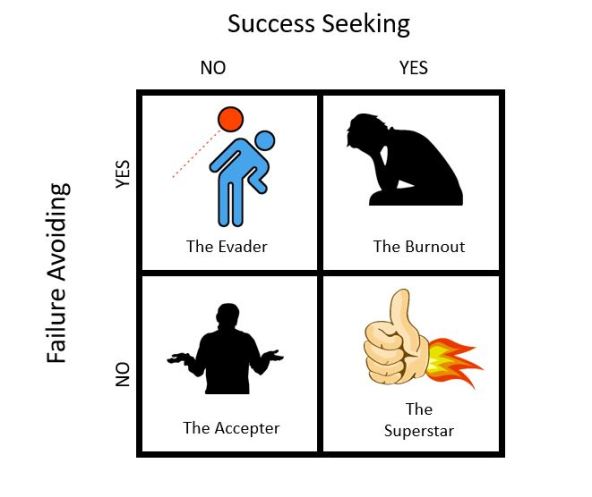
Hopefully, the success and failure exercise helped to gain some insight to your team and how they think about those terms. It should have also help to see who is working toward success and who is avoiding failure. Their answers can be very informative in how they perceive their work, your leadership, and the overall culture of the organization. The answers lead to the four categories of the team in regards to failure or success, superstar, accepter, evader, and burnout.

Everyone wants the superstar as part of their team. This is the one who is willing to make a mistake, but not from negligence. They are seeking better knowledge out of their desire to find the most successful route. I recently finished the book by *Amy C Edmonson called “The Fearless Organization.” In the book, there is a discussion about the types of failure, preventable, complex, and intelligent. Your superstar is making intelligent failures. These are ones categories by “forays into new territory.” They are measuring the risk and taking calculated steps into the unknown for the betterment of the organization.

The superstars are those who are always seeking success. They know through calculated failures and risk that they can learn and improve. As a manager, it a duty to allows these team members to explore and experiment. From my experience, those that create barriers or discourage the process are not usually the direct manager. It will be those that control other facets of the organization. It is our duty to help shield them and assure they get the resources they need to continue excelling in what they do. This is where being a servant leaders is best applied. Be a resource for the superstar and help them feel secure and able to get their best work done.

*Check out the book here from Amazon.com: https://amzn.to/2Hfsmo1

Success vs Failure and a Method of Reflection

When it comes to internal motivation for a professional, I feel that safety has some unique aspects. The discussion last month was about Success vs Failure. I had a lot more questions than answers. When it comes to working in the safety industry our customers are varied and sometimes have very different ideas of what deliverables or items are important. Our company, our employees, the environment, and the community are just a few groups that rely on good judgement, proper ethics, and proper education from the safety person. When it comes to managing or understanding the cultures that make a safety person seek success or avoid failure, there are many aspects and variables that can be evaluated and understood.


The first step to managing is understanding.  Something that I enjoy doing as part of a group activity or even as a method of self-reflection is to conduct a survey of defining success and defining failure. It has been my policy to share my results with the team and allow members of the team to share on a voluntary basis with others. I do required that I get to see the results either as part of a one-on-one or through a text correspondence, which ever make them most comfortable. I even allow typed sheets with no name to be left in my office. I will say, though, that has never happened. They should feel comfortable expressing their opinions. Your team should have a level of comfort and safety with you for this to be effective. If you are a leader of others, I have found this exercise to be insightful and value added in understanding your team and their principles.


By understanding and observing the team, it becomes more apparent of their grouping in success seeking vs failure avoiding. I hope this is helpful and insightful in better engaging and understand your team. There are so many impacts that affect the life of a safety person. Culturally, organizationally, and individually, the safety person is impacted. This shapes the response to issues, the implementation of policy, and general attitude. It is should be the goal of good leadership to observe and impact these variables when possible to create the most effective HSE process.

Here is the basic format of the exercise:

DEFINING SUCCESS ACTIVITY

suc·cess                                                                                                               fail·ure

səkˈses                                                                                                                 ˈfālyər

noun                                                                                                                     noun

accomplishment of a purpose                                                                    lack of success.


INSTRUCTIONS/BACKGROUND:

A key component of a lean system to work towards a goal. This is usually phrased as “what does good look like?”

Once someone knows how “good” looks and is defined, the process can be changed to become closer and closer to good through improvement.

The same can be said for success. Unless we define success, we cannot know if we achieved it.

In this exercise, I am asking you to define success for you as an individual contributor to define what you see success is for the organization in EHS.

With every endeavor there is also a chance for failure, and that must also be defined. I am again going to ask that you to define failure for you and the organization around EHS.

For each question, there should be one to three answers that are no longer than a sentence long. Success and failure should be simple, gradable metrics.

These will not be shared among the group unless you choose to share them. I will use these as part of our one-on-one discussions to help us focus on where the direction needs to be heading.

ACTIVITY: DEFINE SUCCESS

1) Using only one sentence, create one to three definitions of what success is for you as an individual contributor to EHS.


2) Using only one sentence, create one to three definitions of what success is for our organization for EHS


ACTIVITY: DEFINE FAILURE

1) Using only one sentence, create one to three definitions of what failure is for you as an individual contributor to EHS

2) Using only one sentence, create one to three definitions of what failure is for our organization for EHS


When I say safety culture, what comes to mind?

When you think of your organization approach to safety, what picture comes to mind? As a safety professional or someone who is committed to safety, take your personal opinions away. Take the 50,000 foot view of the culture. If your safety climate had a mascot what would it be? What would it look like? Was it good? Was it bad? Was it funny? Was it sad?


Your organization is a series of micro cultures of the pockets personal experience. The individuals working each day are a key determination of how that culture functions and its motivation. Here is another vision question: On any given day, how you categorize or picture the typical leader in your organization? What is their mascot? What is their theme music?


These are strange questions, but they create an interesting outcome of what your safety climate is telling you and how that culture is affecting key results.


I love the lean process. Here are a few quotes from W. Edwards Deming that will help illustrate the point that I have not yet made. 🙂

“A bad system will beat a good person every time.”

“Your system is perfectly designed to give you the results you’re getting”


In my experience, there are really four key organization that are present based on the people that are leading those pockets of influence.

SuccessPIc

The Superstar

The Evader

The Accepter

The Burnout


I hope that we can all agree that a safety person or even a safety team cannot be the key safety cultural influencers in the organization. It is the leadership and the front line supervisors that make those decisions and drive the safety climate of a site, company, or organization. Each day with each decision, the safety culture is shaped and molded into the presentation and personality of those leaders.


Now think of which of these four categories your supervisors fall into. What about the company? What about the organization? How does each feed into the other? How do these traits affect the overall safety system that is in place? What does it mean for the future of the safety system?


I have lots of questions. These are the same questions that I ponder each day. It is through understanding that we as safety people can start to make adjustments in how we manage. This drives the evolution of the safety systems.


For the next few months, I will focus more on these drivers of success and/or accepters of failure, some of the tools I have used, and some of the adjustments that can be made to help adjust, improve, or accelerate the culture of the team.

One Simple Improvement for Safety Training

Mind blowing idea: Not all training is created equal


You probably already knew that, though.


Imagine a simple idea that would lead to better employee engagement, improved training, and safer behaviors. Sadly, it is a commonly overlooked aspect of health and safety training. The answer is to let people know they are receiving training that is for their safety.


I am a huge fan of the research conducted by Dr. Kristina M. Zierold. Some of the works focus on the young workforce as they enter into the labor market for the first time. They receive training, usually on-the-job-training. They are told these are the ways things should be done. But there is no distinguishing the safety aspects of the training from just the way to do the job. In some cases, there is no safety training at all. That, though, is for another time.


So, imagine entering the workplace for the first time. You are given training that is based on the work that you are doing. This is not a bad thing. It helps in building real world cognitive learning of how to perform the job. But, there is not distinguishing what parts of the job are there to protect you, what parts of the job are to help in quality to the customer, or what parts of the training impact other functions. This is where things get sticky.


Safety is not an inherent trait. Safety is something that is learned and observed. With later generations not as much working manual labor at home, being part of shop classes, working on farms, etc. there is a loss of that “common sense” approach to knowing safe from unsafe. As they enter the workplace there then has to be a focus on teaching safety.


For someone new to the workplace, safety systems and protections can appear to slow work down or even seem cumbersome if one does not understand why they are doing it. For a new employee if they do not know it is a safety system, then it is something that could be ignored. They may hear the talk that safety is the most important thing they do every day, and that may very well be true. The trouble is that if they do not know that something is in place for their personal health and safety, then how do they know that they need to always use it.


That is why it is absolutely critical that when training is conducted, the safety features are pointed out. The trainer has a very important role is setting the new employee up for success not only productively but in creating that first feeling of the safety climate. In some places, the standard work can be posted right in front of the workstation. The safety items can be highlighted in green or have a green cross beside those important protective steps. They still need to be trained, educated, and understand why it is a safety feature.


How do we make our safety training more effective? Make sure that as we conduct the training, we communicate effectively the procedures, processes, equipment, and PPE that is place to help protect our employees. Safety training has to exclusively dedicated to the health and wellbeing of our team.

Our data is speaking. Are we listening?

I distinctly remember combing through near miss data one day and having an “a-ha” moment. I could see that trouble was on the horizon. I was for sure thinking that the site was choosing not to report safety issues that really mattered because they felt it was not getting fixed. I had the data to show this was occurring. I had safety committee minutes that seemed to also indicate the same. I had the opportunity to run with my theory and make some dramatic proclamations and changes.


Then I took a few deep breaths . . .


I asked a friend and co-worker his thoughts. Together, we decided that we would go out and ask a few simple safety questions to see if interviews had the same conclusion as the data. To my absolute surprise, there was not an issue. There was not a deeper underlying organizational issue. The employees were not angry or dissatisfied with level of attention to safety. Sure, there were things they wanted fixed. It was not, though, the level of safety climate failure that I was projecting. I was so close to making a very large leap of faith and being completely wrong. First, I thanked my co-worker for his input. Second, I learned to validate and verify my data.


We in the safety profession have a great luxury at our finger tips that we sometimes forget is there. The data we look at every day is living, breathing, people who we can interact and ask questions of on a daily basis. Data is good. It helps in finding opportunities and making recommendations. Validated data is better, and we have that ability at an instant.


Each day there is a real chance to better understand the aspect of our data. Building on the SQDC process of business metrics, safety is the only one that can actually talk and explain the real issues that occurring at that moment. Quality, Delivery, and Cost metrics do not tell a story every day nor do they have the ability to literally tell you what is creating their positive and negative experiences.


There are many times that I have to remind myself to stop, think, and go interact. I know that sounds terrible, but think of all the times in your safety career that you are asked for metrics. What’s our OSHA Rate? How many lost time injuries? What does the trends in the behavioral observations say? How many people are trained in that process? How must waste did we generate? My guess is that you are aggregating this data daily, weekly, monthly, quarterly, and yearly. Along with any time there is an issue or problem solving event. It is easy to get lost in creating, communicating, revising, and managing numbers. The truth is that each number we crunch is a person that can help us understand it better.


Our safety data (aka our people) is talking to us almost constantly, are we really listening?