Five Stages of Behavioral Change: Part 1

In 1983,  Prochaska & DiClemente theorized that there was process of making behavioral change. This five step model was developed while evaluating how people changed from unhealthy to healthy behavior. This was primarily focused on items such as making choices of exercising and eating healthy. From a safety standpoint, there are many similarities in how behavioral change is made. It is not the 8+ hours a day that people spend in the workplace that overall determines their health and safety. It is dependent on many factors including good systems and behaviors. There are many similarities between wellness and HSE processes. The most obvious is the “H” for health. HSE is about health and choices and behaviors that come with a healthy approach to the workplace and risk. So in that spirit of the theory, this seems to apply very well.

Slide1

Stage 1: Precontemplation (Subconsciousness)
The model consists of four “core constructs”: “stages of change,” “processes of change,” “decisional balance,” and “self-efficacy.”

People at this stage do not intend to start the healthy behavior in the near future (within 6 months), and may be unaware of the need to change. People here learn more about healthy behavior: they are encouraged to think about the pros of changing their behavior and to feel emotions about the effects of their negative behavior on others.

Precontemplators typically underestimate the pros of changing, overestimate the cons, and often are not aware of making such mistakes.

One of the most effective steps that others can help with at this stage is to encourage them to become more mindful of their decision making and more conscious of the multiple benefits of changing an unhealthy behavior.

Stage 2: Contemplation (consciousness)
At this stage, participants are intending to start the healthy behavior within the next 6 months. While they are usually now more aware of the pros of changing, their cons are about equal to their Pros. This ambivalence about changing can cause them to keep putting off taking action.

People here learn about the kind of person they could be if they changed their behavior and learn more from people who behave in healthy ways.

Others can influence and help effectively at this stage by encouraging them to work at reducing the cons of changing their behavior.

Stage 3: Preparation (pre action)
People at this stage are ready to start taking action within the next 30 days. They take small steps that they believe can help them make the healthy behavior a part of their lives. For example, they tell their friends and family that they want to change their behavior.

People in this stage should be encouraged to seek support from friends they trust, tell people about their plan to change the way they act, and think about how they would feel if they behaved in a healthier way. Their number one concern is: when they act, will they fail? They learn that the better prepared they are, the more likely they are to keep progressing.

Stage 4: Action(currentaction)’
People at this stage have changed their behavior within the last 6 months and need to work hard to keep moving ahead. These participants need to learn how to strengthen their commitments to change and to fight urges to slip back.

People in this stage progress by being taught techniques for keeping up their commitments such as substituting activities related to the unhealthy behavior with positive ones, rewarding themselves for taking steps toward changing, and avoiding people and situations that tempt them to behave in unhealthy ways.

Stage 5: Maintenance(monitoring)
People at this stage changed their behavior more than 6 months ago. It is important for people in this stage to be aware of situations that may tempt them to slip back into doing the unhealthy behavior—particularly stressful situations.

It is recommended that people in this stage seek support from and talk with people whom they trust, spend time with people who behave in healthy ways, and remember to engage in healthy activities to cope with stress instead of relying on unhealthy behavior.

(https://en.wikipedia.org/wiki/Transtheoretical_model)

The reason I found this theory so interesting is that there is still a belief that culture and behavior can be created quickly. Each organization, and in such, each individual have to go through this process of creating new and positive behaviors. There is nothing about these steps that can be rushed or completed without due time or in their respective order.

So far in my career, I have been part of organizations that are undergoing cultural change because of:

  • 2x = Downsizing
  • 1x = Startup
  • 1x = Expansion
  • 3x = Safety program turnaround
    • 1x = Less than 6 month poor culture
    • 2x = Greater than 5 year poor culture

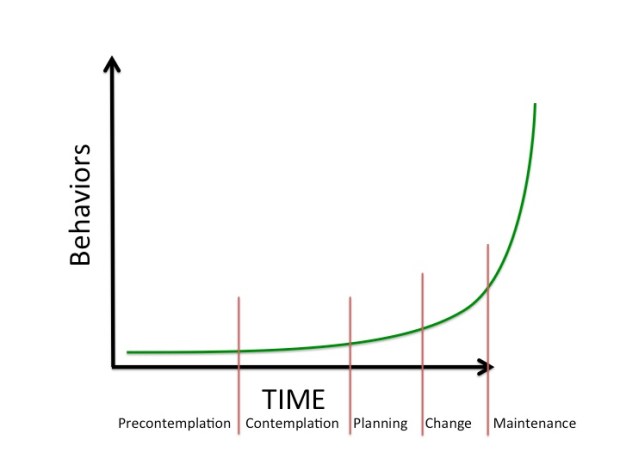
I have seen a trend of how these work. The first six months to one year, the company is patient. They let the work happen and focus on the process and not as much on the results. Then, they get impatient for results. Just like a quality or production problem, they want to see results and now! When we look at the model above, three of the five behavioral processes are all about mindset and preparing for the change. The forth item is where the change actually occurred, and the last is maintaining and improving on the behaviors and culture that has been created.
Slide1

It is my experience behavioral and cultural change is exponential. It takes time for the processes to work and help people internalize that change. Assuming that each of four phases are equal in time it takes to implement (removing maintenance as that is a termination step). It takes 75% of the time to prepare for the change and 25% of the time to make the change. This analysis supports the exponential idea of the process. The best outcomes that I have seen is that for each year a behavior or culture is not nurtured, it takes 50-75% of that time to create a positive culture. For example, a site that has not had a robust safety program for 10 years will most likely take 5-7 years to create the process and results of a good safety program once organization starts making the right changes.

Change takes time. Behaviors take even longer as there are complex emotions and cultures that have to be influenced. The next series of postings will focus on each of the five elements and how they can be applied to creating safety behavioral change.
Changing Safety Norms

A norm is a behavioral aspect of how someone perceives they should act when encountering a situation. In the case of a norm, the perception shapes the reality. For example, a company’s employees have the perception that safety is not important. They make choices to put themselves in unnecessary risk because of the perception.

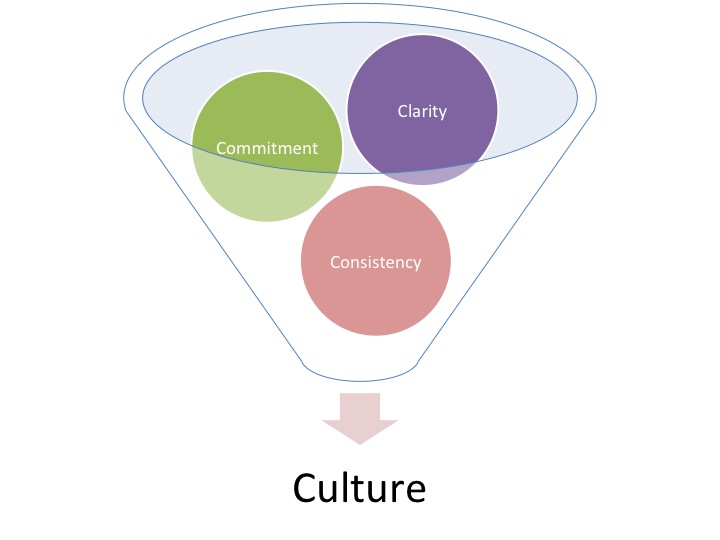
The last post about norms described ways that they can create a positive and negative safety environment. This post will focus on how to change a social norm. The first aspect of change that is critical to remember is that change takes time. A social norm is about culture and behavior. A culture is not created overnight! Here are my three C’s of culture change: Clarity, Commitment, Consistency. In full disclosure, there are many articles about culture and communication that rely on these or versions of these principles.

Three_Cs

A quick sidebar: Most of my career has been start-ups and turnarounds. In these cases, I was either creating the culture from scratch or I was providing the leadership to make a significant cultural shift. Through these “trial by fire” situations, I began to see that there is a process to creating a safety culture. The focus has to on the process and not on the result (an important lean principle). After doing this a few times and as I was describing my work history, someone asked me how did it time and time again. I thought about the question for a moment and then answered. It was from that answer that I discovered these three simple to understand but complex to implement strategies.

Clarity: The message has to be simple and crystal clear. “We want out team to go home the way they came to work.” There has to be no doubt of what is important. Too many times, I have seen a safety talk turn into a production update or a state of the business address. If the message is safety, it should be focuses only on safety. The message cannot be confused.

Commitment: The effort and resources have to be available and utilized. If the message is safety, then safety issues have to be addressed and corrected. Not everything can be fixed at once, but visible and communicated plans can be created. These plans then have to be executed on time as planned.

Consistency: Once the process is in place, like any other continuous improvement, the work never stops. Just because the safety work order backlog is complete does not mean we can stop. Safety issues still have to be addressed and corrected. If safety is not always improving, then it is not being effective. This is where the culture is changed. The visions is set. The resources are working. Now, we have to keep the focus time and time and time again.

It is the culture that is created that will ultimately change the safety norm. To create a positive safety culture and social norm, it takes an extraordinary amount of work and dedication. Every ounce of work invested is pays off in dividends. Unfortunately, it only takes a short amount of time to erode the culture and create a negative social norm. The focus of the organization should be to keep their values in line with the clarity of the vision for a safe workplace.

Understanding Safety Norms

In psychology a Norm is a shared set of beliefs among a group in which there are behaviors that are and are not accepted. The group evolves to have a set of do’s  and don’ts that are established for how they should act in their environment. Research suggests that people will change how they behave based on the perception of the group or situation they are involved with.

Here are two basic and very simplified examples.

  1. When a group of friends get together they find that they always sit in the same places. The social norm for this group becomes to continue that routine.
  2. When someone goes to a friend’s party, they notice many people dressed in blue. At the next party, they decide to wear blue

In example one, the friends create a social norm. In example two, the person perceives the social norm and changes their behavior to match. The key point in example two is that perception creates the behavioral change. The party group may just have a coincidental use of the color blue. The person changes their behavior because they think that blue is the accepted norm even if it is not.

In safety, social norms can be powerful tools for both positive and negative behaviors. Another double edged sword is that once a norm is in place, it takes significant effort to create the cultural and behavioral changes to modify the norm.

Safety people have heard the stories of how crafts people are not really doing their job until they get their first shock, cut, burn, flash, etc. These are cultural norms that are created through the belief that people have to earn through experience. They need to feel the negative before they can understand the aspects of working safe. What happens, though, when the minor lesson learning injury turns into a significant injury or death? The only difference between a first aid and a fatality is luck. The norm creates unnecessary risk.

From a different standpoint, a new employee is trained that there is a full time safety glasses policy. During the on-the-job training, he notices that occasionally others do not wear their glasses all the time. The new employee makes the decision that during a task that has a higher risk of eye injuries to not wear his glasses. This results in a first aid to his eye. During the investigation, it is discovered about the new employee’s perception of the safety glass policy. The investigation then expands to ask those that he was training with about their use of safety glasses. Let’s assume that the culture of the organization is generally positive. The investigator learns that there are times were people feel that safety glasses are really not needed, so they choose to be lax with the use. When the question is asked about the specific task that led to the injury, the employees state that they always wear their glasses performing that task because of the higher risk. The new employee perceived the social norm and put himself at higher risk because of it.

This example is pertinent because it shows how social norms can be perceived and create unanticipated risk. Because the new employee did not know about all the risks, he made assumptions about the process and what would be accepted. This also shows how important mentoring is with a new employees. It is important that the policies are followed. This also speaks to assuring that if a policy is in place, it should be enforced fairly and consistently. Most likely, the supervisor knew that the employees had a habit of removing eye protection during certain tasks. The more the supervisor allowed the team to keep removing the glasses, the more it reinforced the social norm.

Now let’s look at the less dramatic and more powerful social norm using the same scenario. A new employee is hired and is trained on the full time use of safety glasses. As he is being trained, his mentor always wears his safety glasses. When they need to be cleaned or replaced, this is done in a safe area and completed properly. When the new employee sees someone without their safety glasses, he also sees that either another employee or the supervisor promptly uses the chance for constructive coaching about eye safety. The new employee perceives the social norm and always wears his eye protection. He never has a first aid.

So . . . which scenario takes the most energy to create that kind of culture? Yep, the second one. Which scenario creates the most employee engagement? Again, the second. Which scenario would be the one most likely to have the higher quality and better delivery metrics? The award goes to number two. A culture that has a discipline to self-coach and self-correct for safety will also use those same tools to drive all the company metrics. The positive social norm can create behaviors that benefit all aspects of the business. Social Norms can be powerful for a company to utilize and understand.

Cognitive Dissonance in Safety: Part 4

Cognitive dissonance is a psychological principle that occurs when the mind encounters a principle that is contrary to the person’s current belief. The mind creates a “dissonance” between the thoughts as a method of adjusting

This discussion focuses on the aspects of the cognitive dissonance and how that applies to occupational safety.

The free choice paradigm is an aspect of cognitive dissonance that creates a greater difference in a choice when the decision is actually very close in proximity. An example: Someone is given a choice between two very similar items. When they are evaluating which to choose, they rank the two items very close. The person makes a choice between the two similar items and is polled again at a later date. At this time, they create a much wider gap between the two items, heavily favoring the one they chose. The mind wants the decision that it made to be the best choice. So in retrospect, it creates the idea that it made the better choice by a wide margin.

I think as a safety professional, I have found myself doing exactly this. There are times where I am having to explain why I made one choice over another. The regulations sometimes allow a decision to be made on how to conduct compliance. In those cases, it often feels like “six one way, half a dozen another.” Once the decision is made, it is easy to look back and really feel that the decision was clear and well made.

I can remember one decision in particular. It was a start up, and I was deciding which safety glasses was the best choice. The risk for eye issues was low, but still it was an avoidable problem through the implementation of a safety glasses policy. I had narrowed the choice between a light weight more slim line style or a wider slightly more heavy one. Both were equally good choices. Ultimately, the choice was for the wider slightly more heavy style. Some days/weeks later a near miss occurred where a small air hose had come loose and whipped against someone’s face. Instead of striking the area near the eye, it hit the glasses. I remember pontificating quite passionately of “that was why I chose the wider style.”

The truth  . . . the glasses may not have made a difference. The other style may have protected just as well. I see it now as a way that I created greater reasoning for why the decision was made.

In this case the cognitive dissonance was not destructive. Probably annoying, but not harmful. It does show that when we are faced with equal choices, we may be apt to increase the benefit of why we made the specific choice in hindsight or after an event.

For the safety professional, this is an aspect of human psychology to keep in mind. If someone has to make a choice of two equally justifiable items, they could be prone to unintentionally making the choice significantly more favorable than the alternate. This can come in handy as a tool for incident investigations or while gaining understanding of processes and procedures. There may have been a good reason for why something is in place, but there may not have been such a positive difference. In these cases, the facts could speak more clearly than the opinions.

Cognitive Dissonance in Safety: Part 3

Continuing the discussion on cognitive dissonance theory, this post will focus on the induced compliance paradigm.

The experiment that showed this in action goes like this: a group of kids are given a room full of toys. They are expressly forbidden to play with one toy in the room, though. One group is threatening with a mild punishment, while another group is threatened with a harsh punishment. Sometime later, the kids are told they can now play with the forbidden toy. The kids in the mild punishment group were less likely to play with the toy than the group with the harsh punishment. This demonstrated that the only reason the kids in the harsh punishment group had to not play with the toy was that they did not want to be punished. The mild punishment group created other internal reasons for not playing with the toy as they could not simply justify that the punishment was enough. They may have convinced themselves that the toy was not that fun anyway.

The cognitive dissonance is the act of creating a reason for not doing something because the other reasons that are presented do not seem reasonable enough.

This does speak some to motivational theory in that by having large punishments or by having large rewards a goal can be achieved. The behavior is changed, but it is only changed to meet the basic extent of the goal. For instance, a company has a large monetary goal for not having recordable injuries. The team meets that goal not by being safer but by not reporting injuries. Anyway . . . that’s a topic for another time.

I find that induced compliance actually applies more to the safety professional than it does for others. First, the goal is not manipulate people to think about safety. The goal is to create healthy behaviors. As a safety professional, there are conflicting ideas such as: letter of the law, spirit of the law, and risk reduction. A good example would be the confined space regulations that state that once any part of the body that crosses the plain the space has been entered. The spirit of the law is that the space hazards are mitigated, and the person can be rescued. The letter of law sets the standard very clear terms. Without a clear delineation, there could be opportunities to put people at risk. The risk of entering the space versus breaking the plain varies with the space itself. The letter of law is clear so as to create the safest potential environment.

I find that I have to create reasons why to absolutely comply with the letter of law (which is the intent). Many OSHA regulations make sense and can be liberally applied to keeping people safe. In this case of confined spaces, there are so many variations and application that sometimes the best reason is only that the law requires it. Instinctively, when explaining the situation, I want to find practical applications in which to show that the law has assisted in protecting people or reducing risk. I create in myself induced compliance to justify the idea of following the letter of the law.

Now, it is implicit that the letter of the law be followed. That is the intention of any safety professional. This was an example only. I used the example as a time where intuition, risk reduction, the spirit of the law, and the letter of the law may not always be in sync. In these situations in can be normal for someone in safety to create additional reasons to justify the process. Sometimes, the hardest job the safety professional has is to convince others that his services are needed. We take bureaucratic processes and help people realize how those processed keep them safe. Even the safety professional has to sometimes stretch to meet that internal need to explain and justify the existence of the law and the protections that come with it.

Cognitive Dissonance in Safety: Part 2

There different paradigms that are all parts of the overall cognitive dissonance theory. This post will focus on the Belief Disconfirmation Paradigm. This aspect focuses on belief. When someone believes in something and yet is faced with facts that do not support their belief, they have two options. They can either change their beliefs or they can find ways to not only reinforce their belief. Usually the reinforcement of the belief leads them to find people and groups with similar beliefs and leads to attempts to persuade others to join the group. Essentially, they are disconfirming the facts through a stronger belief.

In a non-occupational safety item, the use of seatbelts is an interesting evaluation of this paradigm. Studies show that seatbelt usage will decrease the risk of death or serious injury in an automobile accident by up to 50% (CDC Information). I will use the state of Kentucky as an example. As of 2011, it was estimated that only 82% of the state’s residents used seatbelts (NHTSA Information). It should be noted that Kentucky is a state with a seatbelt law. Since the time of the law the state has seen an increase of 16% greater usage of seatbelts.

So why is it that we know that seat belts save live and is a law yet approximately one in five choose not to wear them? Now for a bit of personal commentary: I have noticed when facing someone who is non-seatbelt user they will instinctively tell a story of a time where they think a seatbelt may have created a situation where someone would have been seriously hurt while wearing one. They may also give names of other people who do not wear them. This is an example of Belief Disconfirmation.

This occurs also in occupational safety. There are ways that this can be overcome. Education is key, overwhelming information that will help in giving people the facts and truth about the risk and how to mitigate that risk. People need the right tools to make the right choices. As a safety person, I cannot assume that people are simply choosing to make the unsafe choice. The first plan should be to make sure they have been equipped with the right information to make a informed a proper decision.

This can also be a case where safety rules do come into play. The makes the choice for compliance clear. Like in seatbelt usage, Kentucky saw the greatest increase in usage once compliance was a law. With that said, a rule alone is not enough. Education is still the critical path. There has to be an understanding of the benefit of the rule and how the rule helps in keeping people safe.

Overall, the process is to help not only present information that would reduce dissonance but also help equip others that might be influence by the belief. The goal is to create opportunities for people to see the facts and understand the process for personal and organizational safety.

Cognitive Dissonance in Safety

The next series of posts will focus on a social psychology theory called Cognitive Dissonance. This series could also be called “Maintaining and Changing Safety Attitudes.” When people encounter information that goes against what they believe, a mechanism in their behavior makes them want to find a way to maintain the current belief.

Here is a very generic example that would demonstrate the theory in practice. An experienced safety professional comes to a new company and realizes some equipment does not have lockout-tagout information posted. Even more so, no one is locking out the equipment when performing minor maintenance or unjamming. After the equipment has instructions created, the training begins. During the training, the safety person encounters significant pushback from employees.

Typical responses would be:
“This will take too long”
“We’ve never had any trouble”
“Why do we need this now”
“This will add too much work”
“We will never have time to make the product”
“Another example of safety slowing things down and causing problems”
“We’ve never had much trouble with these machines”

Just to make the story more interesting, let’s also assume that there have been minor finger amputations and OSHA citations from the same/similar equipment. All information points to that the change to make the equipment safer as a good thing and yet they are firmly resistant to the improvement

Now let’s add a new aspect. During this training, someone else in the room speaks up, “at my last job we had to lockout everything every time. This makes sense to me.” The safety person takes this opportunity to talk about the injuries associated with the equipment and the OSHA citations. Now people cannot believe that they had never had those procedures in place.

This is the heart of cognitive dissonance. When someone is confronted with facts that differ from their belief, they create inconsistencies with the facts so that they can maintain their prior beliefs. It is not about presenting the facts. It is about to modifying attitudes and behaviors. There are various facets of the cognitive dissonance theory that can be explored in regards to safety and how to overcome those thoughts from a negative perspective while enhancing the positive. Cognitive dissonance can be a tough process or it can be a new method of motivation.

Building Meaningful Work Relationships: Part 5

This is the 5th and final part of the series of building meaningful relationships based on Bartholomew’s Adult Attachment Typology Model. This is the section that would focus on secure relationships which is a positive model of self and others.

First though a bit of housekeeping, I am sorry for the delay in getting this post ready. I was in two classes at the same time, which is not normal for me. The one class was the first part of creating my dissertation. It took quite a bit of focus. While I was attending that class, I was also promoted from my current role effective taking on twice the responsibility as before. There was certainly an adjustment period. At the end of the day, something has to give. It was my blogging that had to wait on the rest of my life to calm back down..

OK . . . enough excuses . . . on with the post.

Ultimately, this is a safety blog so this is the post where I will really tie this process back in to the how safety needs good working relationships to work. The whole idea of having a positive model of self and positive model of others is classified as “secure.” A very fitting title.

Many behavior based safety systems focus on the peer observational process. This process has had many praise it and it also has many people who criticize it. My thought has always been that there is a time and place for BBS and the culture of the team and organization has to be ready to embrace that level of openness and change. At the very forefront of BBS is the idea of a “secure” organization.

What this means is that as an employee of a company I am open to give feedback and I am open to receive feedback on safety behaviors. If I am not secure in myself, I may choose to not give the tough feedback or become defensive when having to face a potential mistake. If I have a negative model of others, I would feel that my work or feedback would be wasted on someone who would not use it or not care to hear it.

Without the security of knowing that it is okay to build a relationship in which I can openly give and receive feedback, the process of creating a fully integrated safety system cannot come to fruition. As an organization, we have to admit that there is still opportunity for improvement and as individuals we have to be willing to admit that the change starts with one person making a choice. The goal is accountability throughout the organization in which there can be a full exchange of what is working and what is not.

Security also comes from knowing that the team has my interests in mind when it comes to safety. If I am about to do something that might get me hurt, I want someone to speak up and tell me. I want to be cautioned. I also want to see that same interaction continue with each individual for each task. The only way that this can be effective is if the the team has build truly meaningful relationships in which we are each secure and ready to accept responsibility for the individuals and the team.

The background information comes from the Third Edition of Broderick and Blewitt’s textbook “The Life Span.” The photo of the chart is taken from the same text.

Building Meaningful Work Relationships: Part 4

Building meaningful work relationships is vitally important for not only being successful but also creating contentment at work. One cannot succeed by being alone in the workplace. There has to be some relationships for either creating opportunities to share experiences and to relate to the struggles that come with the position. Being part of a group at work helps in distributing a workload, getting advice, and creating an understanding of the workplace.

Personally, I have found that having a core group of “go-to” people is critical to not only my success but also my sanity. There are unique challenges with every organization whether it be with understanding the practices or navigating the culture. By having a people that you can share those experiences with, it can help ease that uncomfortable feeling. Those go-to people can also share their experiences to help gain understanding of how to proceed. Sometimes, there might be ways to better navigate the cultural waters. Other times, there has to be an acceptance of how things are. It is through these relationships that these ideas and be vetted. Sometimes just knowing that other people are having the same struggles or going through the same experience is enough to help regain confidence and purpose.

When someone is struggling with an issue or waiting to gain control over a situation, they may choose to join a support group. To a certain level, there should be key relationships at work that act as an internal support group. They can be there to lift you back up, give you guidance for success, or be a sympathetic ear when it is needed most. These relationships can also be a good dose of reality when it is needed most. Again, I will speak from experience. There are times I need to be told to suck it up, move along, and stop whining. Your go-to people should also know when that type of motivation is needed.

IMG_1275 copyIn this series of posts, we have looked at attachment theory and how it can apply to building work relationships. In this post, the fearful typology will be explored. This is a situation where a person would have a negative model of self along with a negative model of others. This is a difficult typology to overcome. This is a person who is not engaging others and they are not allowing others to engage them. The fearful status can be rooted in a variety of issues. It can be the work and the inadequacy of the work, it can be fear of engaging other people, it could be a fear of failure, it could be a fear of rejection, it could be a fear of maintaining the relationship, etc. etc. etc. This typology in a workplace has to take time for deep and meaningful introspection. There has to be an individuals understanding of self and what drives the fear and negative model of self and others. Maybe there was an event that led to the behavior.

In this case, it is important that the individual gain the understanding that having work relationships can be a very positive aspect of the job. The fear can be replaced with an understanding that they may not be alone in the situation. If the fear and negative model is strictly a work practice, then building a relationship can be about becoming a more productive and emotionally healthy employee.

There is always some level of stress that comes with a job. Stress on its own is not altogether a bad thing, but it can be a very negative aspect when it is not managed. Here is a link to an article/interview about stress. The key finding was having that support system. Fear can create even more stress in a workplace. Not only does a support system help build positive models of self and others, it also acts as a stress manager. Finding individuals at the workplace that can relate, speak the same language, and have some understanding is a strong beginning to building meaningful work relationships.

The background information comes from the Third Edition of Broderick and Blewitt’s textbook “The Life Span.” The photo of the chart is taken from the same text. The theory is Bartholomew’s Adult Attachment Typology Model.

Building Meaningful Work Relationships: Part 3

In this series of posts, I have been looking at how you can build meaningful work relationships. A theory of adult attachment can give some strong insights to how that process works. In the last post, I made a good description of my most common roadblock of building those relationships as someone who fits a dismissing typology. In this post, I will look at opposite side of the spectrum of someone who had a positive model of others and a negative model of self. This is commonly called “preoccupied.”

IMG_1275 copy

The phrase preoccupied is a good description of this typology and is a concise description of the condition that leads to not building meaningful work relationships. The negative model of self creates an environment where someone is constantly second-guessing or focusing too much on inadequacy to interact in a meaningful way. They person is so focused on the negative model of self that they fail to engage the other groups in any meaningful dialog or activity.

There are three keys ways that someone behaves when encountering information that may not fully understand. The positive behavior of this situation would be for the person to ask intelligent questions, read the relevant policies, try to learn the information, etc. Another behavior would be to ignore the information and substitute one’s own opinion or information. This would fall more into the category of dismissing (positive self/negative others). A preoccupied person would shut down because they would feel that could not comprehend the information or even engage in the conversation in a relevant way.

Someone in the preoccupied typology would have difficulty building meaningful work relationships because there would be a lack of people willing to engage in the activity. If someone who needs information knows that when they ask the question, the person may or may not answer based on the comfort of the situation, slowly they will find other methods to gain their information. People will seek a path of least resistance. If they think they may or may not get a response, they will find a better path that will give them a higher chance of getting an answer the first time. This can create avoidance and thus more preoccupation with the negative model of self. Ultimately, this is a spiral of constantly losing confidence.

A preoccupied typology could also be considered someone who lacks confidence in their work. They can seem defensive or aloof based on how they normally react to an uncomfortable circumstance. There are more aspects to this typology than just what happens at work. In a very broad sense, self-confidence is not something that is bred and nurtured in a work environment. Self-confidence is a behavioral trait that needs growth and presence outside of the workplace. Self-confidence, or the lack of, has larger implications of both nature and nurture. If this were a root cause analysis, I would categorize this as “other causal paths would be more beneficial”. Solving self-confidence is not something I can or am willing to tackle. There are ways that someone can become more confident in their work environment, though. Forbes posted a really nice article that gives some nice examples of how to build self-confidence in the workplace (click here).

The information revolves around slowing growing into a method of making decisions and being okay when making those decisions. Self-confidence at work comes from accomplishing tasks that makes the person slightly uncomfortable and building confidence with those tasks. For example, someone has trouble fitting in with the quality team because the measurements are overwhelming. It becomes important that they have more time to ask questions and work with the tools of department until they gain more confidence with the process. They are doing something familiar but forced to be slightly outside their comfort zone in a safe way they helps them learn. The key is that they have to feel safe even thought they are uncomfortable and most importantly there has to be knowledge sharing.

In a similar context, I have also found that becoming a teacher of a topic is a great tool to increase confidence. For someone to teach a subject, they have to know that subject along with answering questions and having to convey the subject in a meaningful and relevant way. I am not saying that someone in this circumstance should be required to teach an auditorium full of people on a topic they do not know. I will speak from experience that when I started in the safety profession, I had to gain certainty in conducting training. I started with small classes and topics that I have a relative comfort with. The engagement with the classes helped me to become a better mentor and better acquainted with the topic. There are still times that while conducting a training, someone will ask a question that I do not know the explicit answer to. I have to research the topic and respond back later with an answer. This is a system of continual growth for learning and engagement. Through becoming a teacher/mentor/training someone can gain self-confidence in a topic. Most of all they are building strong working relationships with those people who are being taught/mentored/trained. This is one of those times where a solution can help in two ways. It helps in creating a better sense of confidence in a topic along with helping to build meaningful relationships with various members of a team.

Even though self-confidence is not just a single aspect behavior, there are some methods that can be taken in the workplace to help someone with a negative model of self to build really strong work relationships. It is important to start small and to start in an area of relative comfort. The goal is to not shock someone in to a positive model but to help guide them into feeling more comfortable and secure in their abilities.

The background information comes from the Third Edition of Broderick and Blewitt’s textbook “The Life Span.” The photo of the chart is taken from the same text. The theory is Bartholomew’s Adult Attachment Typology Model.