Building Meaningful Work Relationships: Part 2

This is one post where much of the science and research goes out the window, and I will face the facts that I know this typology way too well as it describes me. The focus will be on the struggles and the process of over coming the negative feelings that dictate unhealthy relationships. This typology is one of “Dismissing”

Again, the background information comes from the Third Edition of Broderick and Blewitt’s textbook “The Life Span.” The photo of the chart is taken from the same text. The theory is Bartholomew’s Adult Attachment Typology Model.

IMG_1275 copy

One item to note is that there is no way to build a meaningful relationship with everyone you work around. The goal is to allow you to build those relationships as they become available and in different degrees. There will be those that have a strong connection and create a strong sense of trust. Others will be of a lesser degree. This is a fact of any organization. The goal to makes any relationship as healthy as it can be.

A positive model of self, but a negative model of others is considered a dismissive typology. On the surface, it sounds a bit arrogant. It really has more to do with not having a high level of trust of others, so the focus is always what I can do or what I can accomplish. The deep-dark thoughts that come along with those thought patterns is “I might as well do it myself as someone else will just let me down.” It is not about having a perfectionist attitude, but simply havingthoughts that someone else cannot be trusted. I do believe that this stems from my INTJ tendencies. To see my point, go to Pinterest and type in INTJ. Hilarity ensues. INTJs are well known loners. I fit the mold a little too well.

This is not about me making excuses for what I am but more about the journey of self-discovery and working toward having a positive model of others. For me, creating that model was all about creating trust and building relationships in which trust can grow.

Early in my career, I made a name for myself as a safety cop. I took detailed notes of every encounter, every event that was out of compliance, times, locations, and even sometimes photos of items and behaviors. Why did I do this? I felt that simply approaching people and talking about safety would not yield any results. Sure photos and good notes can help create a strong case for change, but it cannot be the only tool of a safety professional. As you can imagine, this not help me build any relationships that were meaningful and did not help in bringing about sweeping positive safety changes in that workplace. I recognized that the employees feared me, supervisors loathed my reports, and management felt I was finger pointing. That was not the type of healthy work relationship that needed to be built.

In the safety world I have found two types of dismissive models. The first is just what was described above. Everyone is dismissed and not engaged because there is no trust. The other is the dismissive model in which someone does not listen to an idea because they already have the answer. It is common in the workplace where someone will get dictated an answer rather than having ideas free flowing and discovering the answers through a process. Others are dismissed because they are perceived as not as knowledgeable, experienced, intelligent, etc. In the medical world, this would be considered poor bedside manner. The doctor does not have to listen to your symptoms because he already knows what to do. Here is an article detailing some of those finding about physicians. It says that if doctors would spend 10-15 minutes with patients rather than 5 or less minutes, they could see reductions in malpractice claims. The physicians are seen as dismissive because they are not investing that time.

Both of these are unhealthy relationships.

In the first case of having trust issues that create that negative model of others, there are ways that can help. Since that is so near and dear to me, allow me to speak from personal experience. I had to first give trust to build trust. There has to come a point where little pieces of trust are given to others to see how they will treat it. I am not saying that I invite anyone to babysit my kids as a trust exercise. The point is that I had to learn to talk to people and make real connections to understand the how’s and why’s of the behaviors. In a safety cop mentality, someone without safety glasses is in trouble, period. With an integrated safety scope, it is important to learn why. Do they not fit? Was it an honest mistake of forgetting? Did they fog up? Are they scratched? Did the person simply choose to not wear them? Each answer is important but takes a level of trust and understanding. For safety cop, the answers do not matter only the fact there was non-compliance. The situation needed a remedy, but it had to be the right one. Without a meaningful relationship being built those questions do not have a method of fruition.

This change did not happen overnight. There was much introspection before I finally realized what I was doing and why it was not working. I had completely isolated myself and that was not a healthy relationship. I had a few supervisors and superintendents that I apologized to for putting them in an unfavorable spotlight. The next step that I had to do was to ask, “How can I help you make safety a success in your department?” I had to bestow a level of trust in those I worked with. I had to let them help me find the direction I needed to go. I spent more time gaining understanding of the methods and working with people to find the answer.

In the second case where physicians were used as the example, there is a simple trick that can drastically help in this area: Listening. Such a simple word and yet it is so hard to do. We are a culture of actions. Have you heard phrases such as “We’re not moving fast enough” “We need to see results” “We need to get this done now” and many other similar sayings? It is tough in those environments to take the time and effort to really listen to what is happening.

I had the pleasure of being able to participate in a leadership team building exercise years ago. The Industrial Psychologist told us a story of when he was in residency. His instructor asked him if he smoked a pipe. The gentleman indicated that he did not and asked why. His instructedor explained that each time he felt the need to speak, he should puff the pipe a couple times to refrain from speaking. He was not giving enough time for people to fully finish their thoughts. By giving himself a physical queue, he would develop a better sense of giving the moment a few more seconds to assure that all that needed to be said was spoken. I watched the way he worked after that story and noticed that he would put the tip of his pen on his chin. If no one continued to talk, he would interject some of his observations. He had a physical method of reminding himself to take time to really listen to the needs of his clients. The same should be said for building any type of meaningful work relationship. We should want to learn and listen more than we want to talk and explain.

The dismissing typology is a tough one to overcome as it does take serious introspection to see where the faults lie. By giving little bits of trust in key places, slowly there are relationships that start to form. Listening is also a key method of gaining trust. By listening to someone completely, there is an empathy that can be found in the situation or circumstance. That can lead to not interjecting solutions too soon or dismissing the other person’s opinion. Creating a positive model of others comes in two forms: listening to understand and giving little opportunities to let trust grow.
Occupational Relationship Typology: Part 1

To start off, the background information comes from the Third Edition of Broderick and Blewitt’s textbook “The Life Span.” The photo of the chart is taken from the same text.

It is easy to guess that the next sets of posts will be based on a theory from my study in life span psychology. This particular theory in the context of the textbook is in relation to how spouses relate to each other and build attachment to each other. This theory, though, has to some interesting application to the the working environment. Whether we admit it or not, by simply spending 8+ hours each weekday with any group of people there is created certain attachments. These vary in complexity and can create different impacts on the workplace. Many of the recent behavior based safety programs rely on people building relationships with each other in a way where they feel confident and empowered. This confidence and empowerment allows a team based effort in risk avoidance. In practical terms, if a co-worker sees another co-worker performing an unsafe task, they should feel the urge to intervene and prevent an injury. This ability to intervene on the well-being of another co-worker can only come through building meaningful work relationships ( i.e. attachment). There has to be a sense of investment in each other and also a keen empathy toward each other.

The basis of these discussions come from Bartholomew’s Typology: A Four-Category Model of Adult Attachment Categories.

IMG_1275 copyThe theory is simple in that it compares a positive vs negative model of self compared with a positive vs negative model of others. In other words, I have a good or bad feeling toward myself. I also have a good or bad feeling towards other people. Based on how those line up, it affects the type of relationship that be be built.

By having a better understanding of the obstacles that could be in the way of creating positive and meaningful relationships, it creates an opportunity to find better ways of engaging each other.

The ultimate goal of having functional workplace safety programs is to assure that the proper safeguards are in place. The risk has to be managed in such a way as to best protect the people that work around the hazard. There are times where these is risk. It is critical that as individuals and organizations we are able to help each other engage in the safest work practices as possible. If there is an action that could create an adverse reaction, then there should be an inherent social duty to say something to prevent harm to self or others. There are many barriers to overcome in feeling comfortable in having those discussions. Some of those barriers come from “attachment” difficulties based on aspects of the typology. The goal of the next series of posts is to better understand each typology as it applies to the workplace and how to better engage those types in creating a dynamic and positive behavioral safety system.

Compassion, Consistentcy, and Continuous Improvement: Part 4

Much of my career has been focused on two primary types businesses: Startups and Turnarounds. A company has just opened and needs someone to write the programs, perform the training, and create sustainability has many of the same challenges as a company that admits to not having robust safety systems and has a deep desire to create a safe culture. They both have very similar opportunities as far as the way a safety program has to be implemented and nurtured. It is through working in these situations that I realized that creating a real safety system takes Compassion, Consistency, and Continuous Improvement (the 3Cs).

My wife is an avid gardener. As for me, I find it interesting but not as satisfying. That, though, does not stop me from partaking in the fruits (or vegetables) of her labor. I find many similarities between what shes does and what I do. There some very core concepts that have to be applied over and over to make a successful garden or safety program. To begin, it takes the right soil. The ground has to be ready for the seeds to be planted. In this same way an organization has to be ready to begin the journey of not only a safety transformation but a people transformation. This is where compassion comes into the equation. Compassion is the soil in which a safety program should be planted. If the soil is wrong, the seeds will not grow. If an organization does not have the right attitude toward a safety program, it will not produce the results they are driving for.

Next, a garden takes seeds, planting, watering, and tending. It is a lot of work watching over little plants until they can grow to be big plants and produce fruit. In the early stages they take so much more work, but even when they are big the work is not done. The plants can produce on their own, but with the right type of care and tending they have the ability to be so much more productive. For a safety program, this is summed up with consistency. The program has to be nurtured and energy invested continuously. Lots of energy in the beginning but never no energy. There always has to be a level of focus on those programs and behaviors. It is a consistent message to the people in the organization that safety matters and is worth that continual investment in the programs and people. Just if a garden is abandoned, a safety system may fall completely apart. The best case would be that the system is still there and producing minimal results. Consistency to the process has to be a critical component.

Each year when the garden is complete and all the fruits and vegetables are brought in, my wife immediately starts planning how she will plant next year. She goes through a process of evaluating what went well and what could be improved. Maybe she has way too many green beans and not enough cucumbers. One year, the zucchini and squash cross pollinated causing some odd coloration of those two items. Her goal is find a better way of doing the same process next year. What can be improved to make the garden more fitting to her needs. Again, this is how continuous improvement should work with any safety system. A program should be evaluated on how effective it is, the ease or useability of the processes, and how it can still be better tailored to the needs of an organization. Without continuous improvement the system cannot keep getting better. It becomes old and stagnant. If my wife did not find better ways to tend the garden each year, she would continue to waste valuable time and effort to never truly maximize her return. That sounds a lot like a safety system! By not improving the system, it creates waste in various forms that should be eliminated to created better gains and stronger participation.

There are many great books and articles that represent continuous improvement. The whole lean culture is an amazing process driven approach to creating sustainable results. By far my favorite book is “The Toyota Way.” It is a practical look at how lean should support where the product is made. A safety program should provide a great service to its customer. There should never be a time in a safety program where the declaration is made “We are done. We have create a safe place.” This is ripe for errors to start to creep in. It is through a systemic process of evaluation and improvement that a safety program stays fresh, practical, and most importantly functional.

Compassion, Consistentcy, and Continuous Improvement: Part 3

In the first two posts of this topic, I discussed the fact that a good safety system comes at the expense of hard work. Just like any habit or cultural change, it takes time, effort, and desire. I have never found the silver bullet approach to create a sustainable safety program. Simply stated, a robust safety program takes compassion, consistency, and continuous improvement.

This post focuses on the consistency aspect of the “3Cs of Safety.” Previously, I have touched on consistency as part of the Hierarchy of Safety Needs series. Consistency sounds so easy and yet is one of the toughest aspects of the program. I used the example of someone who is trying to loose weight. The first few days are full of energy and ability. Then comes the day where the person is tired and tempted. The choice comes to drop the diet and return to old habits. When the energy of a new program has diminished and the old habits seem easier and comforting, many return to those old ways. It is critical that with any safety system, that the progress is consistent and sustained.

An organization can be the same way with safety (especially with behavior based observation programs). The new program is rolled out, there is energy and excitement for the program. Then there is trouble keeping the system. There could be cost troubles, manufacturing troubles, quality troubles, or delivery troubles. The organizations make a decision to simply put the program on hold while they overcome the obstacles. Then there is another crisis of some form. The program is put on hold again, just until the issues are fixed. This pattern continues until the whole program is just a memory. It is easy to resist and avoid what is new and time consuming. Once the program is lost, it can easily appear that safety is just one more “flavor of the month” style program.

It takes consistency to keep a safety program functional. It keeping the programs going even when faced with other organizational priorities. Creating behaviors and positive cultures takes consistency in its practice. Again taking the example of healthy living, if the process is not kept consistent the gains will slowly or never be realized.

How can an organization keep consistency in the safety program? My first argument to this point is that the organization needs to hire a true safety professional. For example, a company hires an operations manager to keep a focus on operations. A company hires a shipping manager to keep a focus on shipping. A company hires an HR manager to keep a focus on the people resources. Why would an organization think that without a safety manager that they would be able to keep a sustained focus on safety. For a safety manager to be effective, they have to create a sense of consistency, technical knowledge, business acumen, and bring a true position of leadership. If a program has to the potential to slip or be less consistent, it is the duty of the safety manager to remind the organization of the its importance. There is also a duty to find ways to make the program more sustainable, consistent, and easier to implement. One of my big complaints of the safety profession in general are there are too many “safety cops” and not enough organizational leaders.

Consistency is vitally important to keeping a compassionate safety system on the right path and moving forward. A good program is only as good as the length of time that it can be sustained. If today and organization is going to put into place a program to protect employees, the employees should be able to with some certainty guarantee that the program will still be functional a week, month, year, ten years, etc. The same applies in reverse. An employee should know with great certainty that when a legitimate safety concern is raised, that the organization will address that concern with urgency, adequacy, and most important consistency.

Compassion, Consistentcy, and Continuous Improvement: Part 2

During my time as a safety professional, I have come to the conclusion that there are no easy routes to create a safety culture. There are so many gimmicks, sales pitches, online programs, and consultants that try to sell the easy safety approach.

“Decrease recordability by 35% each year” or “The method of behavior based safety” or “Incentivize safety to reduce injuries”

The real truth is that there is not a “silver bullet” approach to creating a real safety system. Just like any other habit or any other behavior, the process has to be learned and practiced. For instance, imagine someone who is overweight and eats unhealthy food. *Can I share a secret with you? This example is me. 🙂 * It is no easy task for this unnamed person to get up one say and suddenly each healthy and workout. The first few days may have some gusto and energy, but the process has to be sustained. After a few days of going through the motions this person might think they have created a new culture. Then suddenly, someone brings doughnuts to work. Oh this person can have just a bite of one and stop. Nope! Four doughnuts later the day is lost and since the day is lost, might as well have fast food for lunch. With that complete, might as well eat out for dinner too. The next day is back to old habits. A safety system is much like this same cultural change. The early efforts are noteworthy and full of energy, but over time the old ways can have a tendency to creep back in. That is why real safety change is so difficult for many organizations. They get a few wins with a new program, and they move on to the next. All the while, the system is eroding and the culture is slipping.

I have simplified my approach to creating that safety system with the “3Cs” Compassion, Consistency, and Continuous Improvement. This post is focused on the first of the Cs, Compassion.

Honestly, without compassion the other two Cs are inconsequential. The safety process will have a large single flaw without having a sense of empathy for the endeavor. Without compassion, an organization would have to ask themselves “what are we consistent with?” Compassion is the foundation on which safety is built. Some might argue that the fear of OSHA or fines would be enough motivation for a safety system. To that I retort that OSHA’s penalty system is antiquated and most time do not affect the overall profitability of most companies. Many of the companies that do create “safety” programs just for those purposes,  the programs do not benefit those they should be protecting. It is only through compassion for employees that a real safety system can be created.

How did I come across compassion as my first key element of a strong safety program? There is a great article that was written by E. Scott Geller that was published in the March 2008 edition of Professional Safety. It was called “People Based Leadership: Enriching a Work Culture for World Class Safety” In this article, he compares traditional safety approaches with new methods of people approaches.

Traditional Safety:
Engineering
Enforcement
Education

People Based Safety:
Emotion
Empathy
Empowerment

In the people based safety methodology there are two terms (emotion and empathy) that both relate to compassion. It is through compassion that the foundation of a safety system can be built.

Why do we have safety programs? Because we care!
Why do we have to use the PPE? Because we care!
Why do we have to fill out these permits? Because we care!
Why do we have to lock this equipment out? Because we care!

I am not sure that there are any other good answers to the above questions. If an organization does not have compassion, the answer those questions above are a shoulder shrug and a “meh.” Without compassion a company may have instituted programs but they are followed or even encouraged to be followed. It is vitally important that compassion is a core principle of any safety system. Without compassion the safety system is paper in a notebook, not a functional program that benefits all those in the organization.

Compassion, Consistentcy, and Continuous Improvement: Part 1

Coming up in the fall, I attend my first weekend long seminar to begin the process of writing my PhD thesis. I am a little behind in taking this first class, but that’s what life will do to you. I am both excited and nervous about this first deep dive into the process of researching and writing the paper. My goal had duality when I began my PhD journey. I will first start with the more selfish reason why I began the process. I had just completed my MBA, and I was in a job where an internal promotion was available. I was never interviewed and at that point I thought, “What’s it take to get an interview around here? A Ph.D!” Two events stemmed from that experience: 1) I started a PhD program. 2) I found a new job.

Beyond my pettiness, the real reason that I began a PhD in I/O psychology is that it really interests me. There are not many researchers that are taking that deep look at the behaviors that drive safety compliance and safer behaviors. I wanted to start my journey of learning focusing on how to influence people so that they are safer at work and home. Now that I am at the part of the program and beginning the process of drafting my thesis, I am honestly a bit overwhelmed. When I start to craft the question that I want to explore further, it continues to get bigger and bigger. I suffer from a case of scope creep. I think of a good idea, then think of a dozens ways to expand it. I do this because I am concerned that my small scope research will not be good enough, and I feel that I need to solve a bigger problem. I keep seeking that silver bullet approach to creating safer behaviors. I want to find that amazing simple answer that everyone is looking for in how to transform an organization to one of safety excellence. The problem with that thought process is that it is faulty. There is one thing my years of safety experience has taught me is that there is no one simple answer to making an organization safer.

All the prior information finally leads me to the point of this post. The answer for a safer organization is really three big topics that are neither easy nor simple. What does it take to have a safer organization (the title gives it away): Compassion, Consistency, and Continuous Improvement. It is the combination of those three items that create not only create a safer organization but creates a better organization. Safety is so people oriented, that relatively small waves in the rest of the business can create big impacts. They are also not felt immediately. Good work in the organization pays off later in safety. It takes time for those changes to impact the influence of safety. Again, it reinforces why I am studying industrial and organizational psychology. It is the interactions between people and the organization that has the largest impact on the safety of the workforce.

In Part 2 of this series, there will be a deeper dive of what does compassion, consistency, and continuous improvement mean for safety. Unfortunately, they are not easy topics to define, implement, or quantify. These items take organizational excellence to accomplish, which would also explain why so many companies struggle with safety excellence. This, though, makes sense. If it was easy everyone would have mastered it.

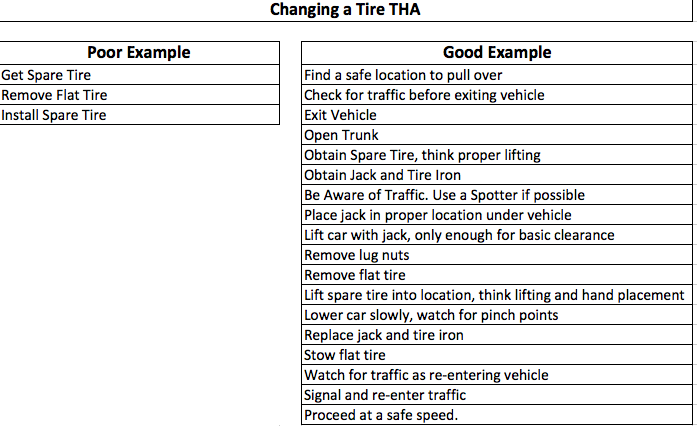
Example of a Task Hazard Analysis

There are many ways to perform a pre-job safety brief. The best method is a Standard Operation Procedure (SOP). This method creates a formal documented way to performing the job, the PPE required, and steps necessary to perform that work. An SOP works best with a routine job where the safest method has been previous established. Certainly, though, revisions and improvements must always be encouraged.

A Job Safety Analysis (JSA) is usually a check sheet format that has those performing the work check yes or no to is the hazards are present. It would also create an opportunity to see if other permits such as Hot Work, Confined Space, Line Break, Trenching, etc would be necessary. It is somewhat of an intermediate between the THA and SOP. Screen Shot 2015-06-12 at 7.13.08 PM

The goal of a THA is to create a working set of steps that helps in identifying the hazards (think “what if”), and evaluating ways that would make the work safer through an organized task focused approach. The process works best in team as an individual might miss some key steps in the process. The team approach allows more than one set of view points to think through the process and have time to evaluate the potential hazards and steps necessary to limit risk.

As a disclaimer, most THA templates offer guidance through the use of check boxes to ask the used to consider a wide range of potential hazards and PPE that might be necessary. The example above is one in regards to breaking a job into detailed sub-tasks so that they can be evaluated.

Typologies of Safe Behaviors and Safety Programs – Part 7

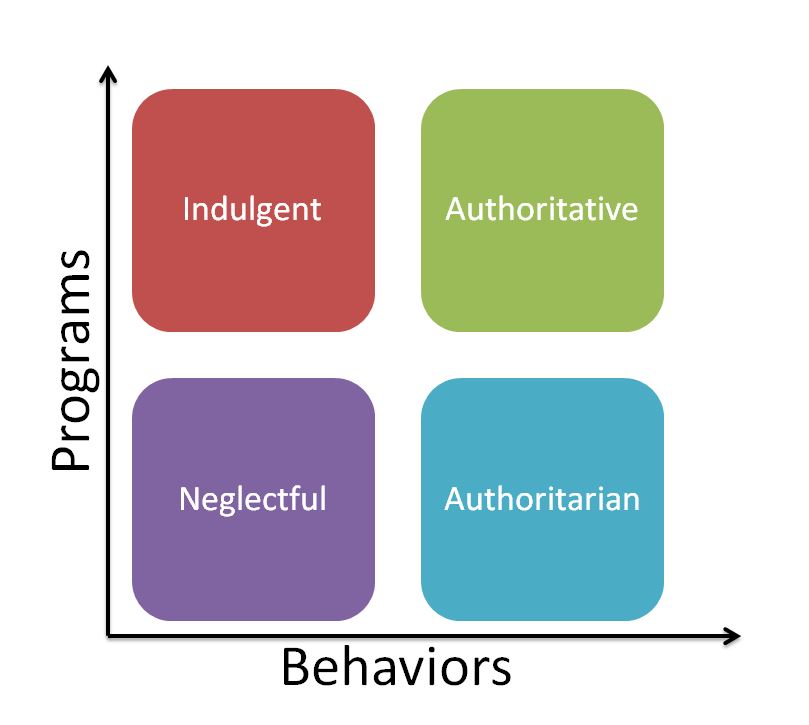
This is the final post in regards to the the safety typology based on Baumrind, Maccoby, and Martin’s parenting styes. This posting will be shorter than the rest because it focuses on the high programs and high behaviors typology of Authoritative. This the goal of any parent/organization. There are high expectations along with high support to assure success.

SafetyPgmsBeh“Even with high expectations of maturity, authoritative parents are usually forgiving of any possible shortcomings. They often help their children to find appropriate outlets to solve problems. Authoritative parents encourage children to be independent but still place limits on their actions. Extensive verbal give-and-take is not refused, and parents try to be warm and nurturing toward the child. Authoritative parents are not usually as controlling as authoritarian parents, allowing the child to explore more freely, thus having them make their own decisions based upon their own reasoning. Authoritative parents will set clear standards for their children, monitor the limits that they set, and also allow children to develop autonomy. They also expect mature, independent, and age-appropriate behavior of children. Punishments for misbehavior are measured and consistent. Authoritative parents set limits and demand maturity. They also tend to give more positive encouragement at the right places. ”

Exchange the word parents for the work organization and remove the references to children, Voilà! You have a well functioning organization. Here is a quick recap in terms of safety and functional excellence

1) High expectations
2) Empathetic
3) Find ways to help employees solve on-the-job problems (see The Toyota Way).
4) Has limits, buts wants exploration of better ways
5) Encourages give and take communication
6) Wants the organization to make good decisions based on experience
7) High accountability
8) Discipline is measured and consistent
9) Gives positive encouragement and feedback
10) Clear expectations

Is any organization perfect? No! An organization that reaches a point and feels they have done enough lives in folly. One of the key principles of keeping an organization vibrant is continuous improvement. The key of an Authoritative environment is that everyone is engaged in the improvement process. Each day the team as a whole is looking for ways to make small improvements that keep the momentum heading the right direction. An authoritarian typology is not only a great benefit to a safety system, but a great management system. When I read book like Built to Last, Good to Great, and the Toyota Way, they each detail different versions of an authoritative system. It is an organization that relies on each member of the team to make a contribution to improve the company.

Overall, the authoritative typology is where an organization should strive to be, but with the understanding that improvement never stops.

Typologies of Safe Behaviors and Safety Programs – Part 6

In these post, I am exploring how an organization would look based on high and low criteria of behaviors and programs. I find the outcomes to be very similar to the parenting typologies of Baumrind, Maccoby, and Martin.

SafetyPgmsBeh

This time I review the opposite approach of the authoritarian typology, indulgent. This is a safety environment where there are good programs but there is no accountability for overall safe behaviors.

For the parenting typology, “permissive parents try to be “friends” with their child, and do not play a parental role.The expectations of the child are very low, and there is little discipline. Permissive parents also allow children to make their own decisions, giving them advice as a friend would. This type of parenting is very lax, with few punishments or rules. Permissive parents also tend to give their children whatever they want and hope that they are appreciated for their accommodating style.”

This relates well to how the safety environment would function with an indulgent typology. It seems that the organization is attempting to avoid conflict by simply allowing to happen what will happen. There are few expectations set of how the organization should look and perform. It is interesting to see that the goal of indulgent parenting/organizational structure is to hope that by being given everything there will be an sense of appreciation and respect. Usually, the result is entitlement.

This typology is easy to spot during a reviewed. During the records and programs review, everything looks great. Written programs are in place, training well documented, and it is well kept and organized. Once the auditor steps into the work environment, none of those programs appear to exist. In the office a lockout tagout program is well written, complies with regulations, and has training attached. Then there is someone who is waist deep in a piece of equipment with no lock, no tag, and maybe not even turned off (the interlock works, right?). The auditor might ask what is happening and the response would be something like, “we got to this equipment back up and running.” or “we do this repair like this all the time.” or might ignore the auditor all together because no one has time for a safety audit while there is production to run.

This is one of those typologies where I look toward the safety person to see how their interaction with the organization creates this result. It could be that the safety department has no real or political power within the organization. The programs and training are all in place, but when a view of the operational environment there is no evidence that the programs are followed or considered. There are a few reasons that this phenomenon could occur. The first is that the safety department never leaves the office. They write programs. The perform training. They never go see how the programs could or could not be utilized where the work happens. Another consideration is if the safety department has a good relationship with the operational department especially the front line supervisors. The front line supervisors should be a safety professionals best friend. They are able to make sure the programs are actually working. They can provide feedback on what works and what can be improved. They can help with ideas of where improvements can be made. The front line supervisor, when truly carrying a safety banner, can make a significant difference in a safety culture of an organization.

In the case of an indulgent organization, there are reasons why the well written programs are not followed. Some quick check items to review:

1) Is safety a critical ideal of the senior leadership?
2) Do supervisors and employees have all the tools they need to comply with the safety programs?
3) Is the training relevant and adequate?
4) What types of audits are being conducted to report deficiencies to the organization?
5) Are the expectations clear enough?
6) Is there an understanding of the programs and how to use them?
7) Are there work rules that require the following of safety procedures?
8) Are those work rules enforced? How?
9) Are safety performance items part of everyone’s annual performance review? (Not safety metrics but deliverables such as audits, improvements, and observations).
10) Are safety committees functional?

These examples are some quick start ways to engage the team in creating those safety behaviors based on the programs.

During job interviews that I have been part of over the years, one of the common questions I receive is, “How much time do you like to spend on the shop floor?” Why is this questions asked? It is because those who are asking it have met safety people that simply want to write programs and never leave the office. As a safety person, I do rely heavily on the front line supervision to really make safety work. But I also have to be present to see how I can help make the programs better, easier to use, and to coach others on assuring the programs are working as intended. There is a level of support that has to be given to front line supervisors to assure they are successful in making safety a functional part of the organization.

An indulgent organization can be transformed relatively quickly compared to neglectful and authoritarian. The goal is to create purpose and accountability in the workplace through the programs and by the whole team.

Typologies of Safe Behaviors and Safety Programs – Part 5

This is a continuation of the thought experiment in the consideration of what does an organization look like based on two criteria, behaviors and programs. To make the process simpler, the goal was to view the process that an organization has either high or low behaviors and programs. This gives four options for how the organization can be classified. As the exercise continued, I began to see that that four types of organizations were very similar to the parenting typologies that are theorized by Baumrind and later Maccoby and Martin.

SafetyPgmsBeh

In this post, I will remain in the low program zone and move into high behaviors. This would be categorized as an authoritarian organization for safety.

According to the parenting typology, “authoritarian parenting is a restrictive, punishment heavy parenting style in which parents make their children follow their directions with little response. Children resulting from this type of parenting may have less social competence because the parent generally tells the child what to do instead of allowing the child to choose by him or herself. Children raised by authoritarian parents tend to conform, be highly obedient, quiet and not very happy.”

These traits can be transferred to the workplace. The biggest way to categorize this type of safety organization is fear. The company creates a strong sense of fear for failing to follow a safety rule. Rather than empowering the employees with programs, training, and interaction; it is all dictated with minimal clarity and heavy discipline for those that do not conform. Some other considerations of this type of environment would be how much turnover the organization sees. Fear is a strong way to govern (see Machiavelli’s “The Prince”). It is effective in keeping the organization structured, but people exit frequently (both forced and voluntary). This type of organization might pride themselves on how many people they have terminated for safety issues and claim that this stance shows great support for the safety endeavor.

In recent years, OSHA has been critical of safety incentive plans that focus alone on recordability and lost time rates. An authoritarian safety program would rely heavily on these types of programs. The goal is not to create good programs and learning environments, but to stop the reporting of injuries and hold individuals absolutely accountable for their own safety. Safety committees might exist, but they exist only as a check-in-the-box approach. They would have no budget or empowerment for change.

Overcoming an authoritarian culture begins with empathy and empowerment. The organization has to accept that there has be consistency in the programs. The programs also have to empower the employees to help improve and create those programs. When there is a sense of ownership, there also comes a sense of pride. The organization has to directly seek out input on how to improve the way the organization performs. It cannot simply be an act of collecting data and not creating action. The trends will be apparent. There will be a certain amount of pride that will have to be put aside along with an admission that the company may need input on how to improve the programs and that all the answers cannot be simply dictated to the employees. One of the largest hurdles that would have to be overcome is defeating the sense of fear and replacing that with a sense of accountability and ownership. Investment back into the employees is a great starting point,. Specialized training and employee input to programs will go a long way in moving the process forward.

Overall, an authoritarian environment must accept that program have to be in place to help gain consistency and fairness along with eliminating an overwhelming sense of fear.