Measuring SQDC in Safety

For a safety department to be its most effective, it requires the evaluation of the group along similar metrics as others. I have been fortunate to have had some really good mentors in my career that have helped me to craft the way I look at running a safety department and measuring success.


In most major industries there are four key metrics that they are responsible for. I have seen this same method/metrics in automotive, food, and chemical. It is a positive process as it shows the balance that must to struck to have a successful business. These metrics are Safety, Quality, Delivery, and Cost or simplified as SQDC. A business can run without these metrics in harmony, but they are rarely highly successful.


So, what does it mean to measure to SQDC in a safety department? Here are some of the ways I have found make it the most meaningful for the team and larger organization.


Safety:

This is what we do, so it should be simple, right? Yes and no. I have always thought about what is the safety metric for a safety team. First and foremost, a safety team should not get hurt. They should be cautious and aware.


Beyond injuries, this metric for me has always been more about the message that I am carrying with me every day. What is the thirty second elevator talk that I would give that day to communicate safety to anyone. One lesson that I have always found to be true in safety is that you cannot overcommunicate a message. People need to hear a safety message as much as we can get in front of them.


Examples could include:

“Did you hear about the near miss yesterday? Here is how to stay safe”

“I read in the news of an injury happening. We have that hazard. Here is how to stay safe”

“Did you know we have not had ‘insert event here’ in a long time? Here is what we have been doing right.”

“Some bad weather is moving in today, remember our evacuation plans for bad weather.”


It is important that communication is a big part of how we define success in safety every day.


Quality:

Quality for a safety professional is based on our policies and procedures. Are they up-to-date? Are they relevant? Do they help those who they are meant to service? Have they been reviewed on some basis?


Where we help to maintain the high standard of quality is through assuring our processes and procedures are in good condition and help set the basis for accuracy, precision, and consistency.


Delivery:

Delivery is the service we provide to our customer. These can be in the form of audits that help find ways of improvement. It is the time that it takes to answer questions about the policies. It is also the metrics that we report out as part of the standard work. Each day the safety professional is called upon to deliver any number of these styles of items to the organization.


Cost:

There are a few ways to look at cost in the safety department. The first is helping to create and maintain a working budget. Be accountable to predicting big projects and special needs. Communicate early and often when there will be misses. Help the organization see where you need funding to help sustain and create strong processes to make the site safer.


Some organization also measure workers’ compensation costs. These can vary from state to state and are very reactive. They still, though, can heavily affect a company’s bottom line. It is important to measure and manage this process.


Overall, running a safety department with key metrics that match and mirror other departments helps to build transparency and trust into the system. These processes are valuable as they can help the internal team and the organization to see that there are processes that can be measured, implemented, and improved.
When Your Safety System is not a System

There are times where a company will seek to implement a safety program. They will create all the necessary programs, procedures, meetings, audits, employee committees, and many other processes that they feel have made other companies successful in safety. They will even brand all the programs as their safety management system or process. The trouble, though, is creating the linkages that actually makes the safety system functional. Just having all the parts of a system, does not make it work.


A functional and successful safety program actually needs to be a system of components that work with each other and communicate effectively across one another. Imagine a human body with no nervous system. It has everything it needs to be alive and working, but there is nothing that makes everything work together. There is no harmony. There is no communication.

Slide1

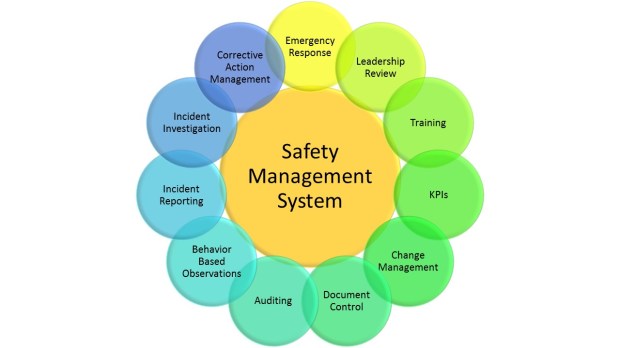
The model provided is not extensive map of everything that makes up a safety system but is a representation of how everything needs to interact in a way that is functional. Each piece is equal to one another and has to complete a communication loop with all the other functional systems. It is the safety management system itself that acts as the bond between the items.


The idea of a safety management system is quite ethereal in talk, but exceptionally valuable and tangible in practice. I have personally seen organizations that have all the components of a safety management process but the system was not there. Auditors would come in, see all the pieces, and yet feel there was something just out of their grasp that was not right. Here is my shameless plug: This is where an experienced safety professional is invaluable to an organization. They are the ones that personify the system in action. They create those communication bridges and help make the system functional.


So what are some of the ways that safety management systems fail to function? I am glad you asked:

  • Lost in translation: The management system is the great interpreter of the all the parts. The Emergency Response Plan has to be able to talk to the Management Review in a language that they both understand. I remember early when the ADAAA was enacted. The workers compensation laws were affected. The idea was that if there was a job that a restricted employee could perform, the organization would make an “offer” for the temporary position. This created quite the confusion with the HR team on their version of job offer. There had to be someone to help each understand the other. With that idea in mind, does your safety management system help to allow each part be understood by the other?
  • They just don’t talk anymore: Each part has to communicate with the other. Does the change management program ever talk to your KPIs? If so, how? The best way is to map it out. Take each part of your management system and make a grid across the top and bottom. In each intersection there should be some methods or process that facilitates communication between each item. This can be a time consuming project, but it is exceptionally revealing in the functionality of the system.
  • There is no feedback: Communication is a two-way street. One part of the whole cannot simply dictate to the other. They have to be giving feedback to one another and improving from that communication.


A safety management system is vitally important to the overall health of the safety programs. Unfortunately, there are times where that system can cease to function effectively. When a situation arises where it seems that everything is in place but something does not feel right; take a moment to assure that your system is communicating.

Linkages of Behaviors and Conditions

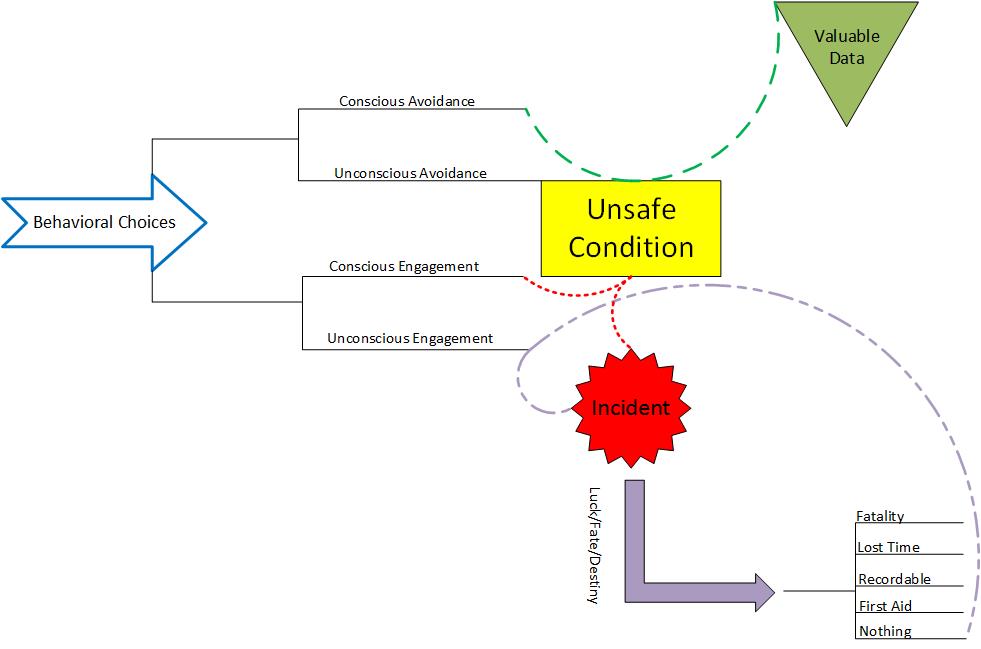
As safety professionals, we are always evaluating the linkages between conditions and behaviors. It is the behavioral choice that leads a person, both at home and work, to engage a condition that could be thought of as unsafe. From my work on the behavioral and training side of safety, I feel there are four ways that the conditions and behaviors come together to either improve a safety culture or lead to incidents or injury.

ConditionBehaviorInteraction


The first behavioral choice when encountering an unsafe condition is Conscious Avoidance. The person sees the condition, knows it is unsafe, and makes a fully conscious effort to avoid it. This is one of the most positive behavior-condition interaction. This creates valuable data for the organization and culture to go and fix and issue before it leads to an incident. The act of consciously knowing the hazard would suggest they would follow the system to report and remedy the unsafe condition.


Example: Someone sees a puddle on the floor. They recognize the hazard, place a cone to notify others of the hazard, and reports it appropriately. A maintenance team is notified and fixes a leaky pipe. The environmental team is deployed for cleanup. The site fully benefits from this engagement.


Unconscious Avoidance is where a hazard is avoided but the person is not aware that they avoided a near miss or incident. It is good that they have an unconscious ability to avoid a hazard that the back-brain has determined to lead to injury. This is a primal reflex to avoid harm. The problem is that this does not help anyone else avoid the hazard. The hazard still exists. For those who might not have the finely attuned instinct of the Unconscious Avoidance, they would engage the condition and have the potential for injury.


Example: There is a puddle in the floor. Our Unconscious Avoider, changes their directional path to miss the hazard entirely. Nothing is reported. Nothing is fixed.


Where the Unconscious Avoider leaves the hazard in place, now enters the person that is Unconsciously Engaging the hazard. Once the hazard has been engaged, there are a few paths that are only directed by fate, luck, destiny, or whatever you want to call it. The site may get data from it, but only in the case of injury data or as a near miss. The Unconscious Engager can have an incident that leads to any number of consequences which can be as severe as death or as simple as nothing.


Example: So here is our ever infamous puddle on the floor. The Unconscious Engager (UC) does not waver or swerve. They walk right into the puddle. Here is where, it is complete out of our control. As a D&D fan, I will use the D20 analogy.


  • The UC rolls a 20, critical save. They walk right through the puddle. No slip. No Fall. Not even a loss of traction. Since this is a 20 roll, they recognize they just walked through a hazard and report it, so it can be fixed.
  • The UC rolls a 17. They walk right through again. But this time there is no report.
  • The UC rolls a 14. They lose some traction and report it as a near miss.
  • The UC rolls a 12. They lose some traction, but makes no report
  • The UC rolls a 9. They slip and fall with only a minor bruise. First aid only.
  • The UC rolls a 7. They slip and fall with a sprained ankle that needs medical attention. OSHA recordable
  • The UC rolls a 5. They slip and fall with a broken shoulder. Severe injury and lost time.
  • The UC rolls a 1. They slip and fall striking their head with fatal severity.


This example is not to make light of the severity of personal injury and suffering. There is nothing humorous about someone getting hurt from Unconsciously Engaging a hazard. The point of the example is to illustrate that once a hazard is engaged, there is nothing anyone can do to change the outcome. It is all up to the infinite variables of the universe. As safety people and people who care about safety, it is all about creating behaviors that mitigate unsafe conditions.


The final behavior is the most uncommon for good reason. It is the Conscious Engagement of Unsafe Conditions. In my career, I have encountered very few of these behaviors. These are ones who are actively seeking a method for injury. They want to create an example, utilize the system for personal gain, demonstrate their level of disgruntled attitude, or some other underlying motivation. Their goal is to exploit the unsafe condition to actively get hurt. There is still an element of uncertainty as they can never fully predict on control the outcome. They do, though, try to maximize the event to meet their personal goals.


Example: Once again the puddle is in the floor. The Conscious Engager walks rights through, assures they end up on the ground, and begins shouting for help. The injury leads to long term restricted duty and a moderate impairment rating with a final reasonable workers compensation pay out.


We cannot control the Conscious Engager before their intentions are known. What we can do is eliminate unsafe conditions. If we take away the opportunity, we create a better environment for all our people.


This interaction between behaviors and conditions is one that I have thought about for quite some time. It was actually an operations managers that said it most elegantly. He said that if we eliminate the unsafe condition we take away the opportunity for those who want to play games, and we create a better site. This led me to map out the chart and create the diagram. It was my desire to first understand the scope of the behaviors. From better understanding how the condition and behavior interact, it can help organizations lean to engage and empower their teams to create a real and improving safety culture.

The 5 Pitfalls of Safety Metrics

5. They are Reactive
OSHA rates were never meant for the process of being competitive metrics. Their use was to create comparisons for better understanding of injuries and focused programs. If the only item that projects bonuses or success for a company is injury rates, then the organization is missing the point entirely. Injuries should be qualitatively studied, and they systemically prevented. The data they provide is nothing more than a method of knowing where problem solving needs to occur. Once an injury has occurred, there are so many systems that have failed in the organization to create that deficiency. Using that metric as a driving force is akin to being tracking a quality metric of customer issues that resulted in catastrophic failure.

Items to Consider for Improvement: Quantity of safety work orders, time to close safety work orders, capital dollars spent on safety projects, hazards mitigated, safety audit findings closed, compliance calendar items closed on-time, employee interviews, safety committee projects.

4. They are not Meaningful
Maybe it is great that an organization has five safety observations per employee per day. What is happening to that data? Is the data real? Sadly, I have heard of too many times where these audits are being an exercise in the creation of paper. The employees are creating sheets of paper with check marks on them to simply stay off the “bad list” of people who are not performing their audits. Here is a quick litmus test of if the metrics are meaningful. If the safety audits stats are posted in a public area are employees really interested in the results or do they walk past and roll their eyes. Employees know the truth of those metrics. I have heard too many times “We has rather have one good audit that makes us better than 100 that are pencil whipped.” Yet, that same organization continued to grade employees on quantity. If safety is important to the organization, then why to we allow this process to be driven by sheer quantity when quantity is at the expense of quality.

Items to Consider for Improvement: If you were to present the metrics to the site safety committee, would they find the data actionable and meaningful? Even better, ask employees what data they want to see. It can be insightful to see the items that employees find interesting or important to the their daily work. Most are curious about safety because it directly affects them. Don’t be afraid to get that input.

3. They are not Timely
Here is the scenario: A chemical company has a major release. The regional news is carrying days of coverage, the Chemical Safety Board, OSHA, EPA, and other agencies perform investigations. Everyone knows that a the site in their company / division / region / etc has had this significant event. The company proceeds to publish nothing internally to help other sites learn from the event. Over a year passes and the company releases a lessons learned and policy change based on that event. Those corrective actions are important but by this time they are meaningless to those working in the company. It has been too long. The employees are no longer as passionate about that event. It also sends the message that safety is not important. If production numbers or customer complaints are negative, the company adjusts immediately. Something that gains media attention takes over a year to fix. The importance and prioritization is not there. These corrective actions and the closure thereof has lost the meaning to the people which is who those actions should be protecting.

Items to Consider for Improvement: Any metrics that are being tracked or published should have be timely enough have impact on the employees. Even is there is a smaller event that only affects the local site, the information about the event and the corrective actions should be communicated soon enough to still make a difference to the employees. They should still have passion and concern for making a course correction. This will help in gaining acceptance to make those changes in a fast and sustainable way.

2. They are not Actionable
Each month the safety committee reviews the corrective actions that are over due that are safety related. Each month a few get closed and a few more go overdue. It is a continuous cycle. If the metrics are not driving a change to the organization there is no sense of continuing to collect them. I have seen where an organization required safety audits. The only data required to be entered and tracked what the quantity of audits performed. There is no action that is meaningful or has any impact to the safety of the team. The only action that is driven by the process is to create more paper. There was a huge miss in using that data to create real organizational change. There has to be a way for the data to have an action. If the site sees too many overdue corrective actions, then there should be a process to get focus on them and close the actions. If audits are being performed, there should be a way to create actions from the meaningful aspects of the data.

Items to Consider for Improvement: If the organization has a metric is has to also have a method for creating action. If the metric does not drive accountability and changes for the better, why continue to waste time collecting it. There should be a process for evaluating the data and finding meaningful ways to create action for the benefit of the employees.

1. You’re Guilty until Proven Innocent
This was an issue I just recently had to think more about. I saw a metric where there was a tracking issue of work delays. Sometimes, the work was stopped for reasons that needed to be corrected. Other times, the work was delayed to make the areas safer. If the work delay was not appropriate, there should have been corrective actions. If the work was delayed to make the work area safer, there should be positive recognition and rewards. The metric for success or failure did not have any differentiation from appropriate and not appropriate work delays. The supervisor either hit or miss the metrics. I was struggling to understand why supervisors were rushing even when safety was a factor. The leadership team did a nice job of recognizing supervisors when they delayed work for safety, and there was never any negative repercussions from stopping a job to make it safer. It finally struck me that the metric assumed the supervisor was guilty until they proved themselves innocent. They were in trouble for having the delay until they explained in the shift report or verbally that it was a safety issue. They did not want to have to prove innocence, so they rushed to never be delayed. We has the leadership team had to change the metrics to exclude all safety items to assure that we empowered the supervision to take time for safety. We had to make it easier for them to be innocent and not called out on a metric that they would have to explain away.

Items to Consider for Improvement: If employees are supervisors are avoiding certain metrics or items, ask why. Also, take time to think through graded metrics. Do the metrics make any assumptions of guilt? If so, there has to be an over-communication of the scope of the metric. To create a proactive and safe environment and culture, the metrics have to empower the supervision and employees not encourage avoidance of attention.

The Evolution of Safety Auditing

There are many ways that safety programs are audited and evaluated. There are some that are internal to the organization or site and there are others that are used external. Some companies use the idea of intra-site auditing where safety people from other sites perform a documented audit on another site. Year-over-year there are rotations among all the sites. The other choice is the organization chooses to hire an external auditor on a contract to perform these evaluations. There are also opportunities to leverage the organization’s loss prevention or insurance company to assist with performing or coordinating audits.

As a safety professional, it is easy to enter a site an find multiple unsafe behaviors or conditions. From a strictly technical standpoint, there are always opportunities for improvement. The reason an audit should be conducted is to get an idea of where the total compliance attitude sits on the organizational scale. Getting lost in the trees and forgetting that the forrest exists does not create benefit.

Regardless of how an audit is performed, there are some basic items about an audit that gives indications about the performance of the audit team, the site behavior, and the organizational culture. I have created a scaled list of how an audit should give insight to the organizational compliance.

Poor performance = few findings. High complexity

When a site is still developing the audit should be focused on big ticket items like: creating a lockout program, training employees on hazard communication, performing personal protective equipment surveys, and creating written programs. Inundating the site with lists and lists of detailed items is not helpful in this phase. They should be focused on simply developing programs. It is the idea that something is better than nothing. The natural cycle of continuous improvement will help the details become addressed.

Medium Performance = high findings, low complexity

When a site has become the typical performing organization, the transition begins to see more punch list style items. Depending on the overall performance of the site, this will drive the number of those items. The major items of program creation are gone. In their place is a list of items that need to be completed to enhance compliance such as labeling specific bottles, updating placards, and

Good performance = Few findings, low complexity

One of the best auditors I know has three categories of findings that he creates as part of his process:

Nonconformities are findings where the program is not implemented or not followed

Deficiencies are where the program is in place but there are elements that are not up to the standard

Opportunities for Improvement are where the auditor finds ways that the program can be improved and is fully in compliance.

A good performing plant will be mostly focused on the opportunities for improvement. The complexity will be low, there will be minimal findings, and the goal is to keep the momentum rolling. The site has many good aspects of the program, but even a good program can go bad if it does not seek continuous improvement.

Overall, the process of auditing is value added when it is properly scoped, controlled, and helps create improvement in the process. The sake of auditing for auditing sake is overall a losing prospect. The audit program should have a governing policy and process that should be followed. There should be a defined outcome and mission statement for the audit. It is through planning and a focus on improvement that the audit program brings true value to a safety organization.

Safety: Behavior or Motivation

I was recently at my final residency. Part of this process was to complete my dissertation research plan. The discussion around my topic about safety was talking about the theory behind the process of safety psychology.

 
On a complete side note, I did learn that with a qualitative research plan the theory is really something that gets built into the process as the research is conducted and not as a basis like quantitative research.

 
Back on topic: One of the discussions in my group was if I was studying behavior or if I was studying motivation. This whole discussion turned my thoughts upside down. Since I first began in safety over twelve years ago, I have been told that changing people’s behaviors was the ultimate goal of the safety professional. What if for all this time, I really should have been seeking to create motivation not change behavior. Mind blown!

 
With this new way of looking at how safety should be integrated into a organizational culture, it begins with the most simple thought: why do people need motivation to be safe? The over simplified answer is that going home whole should be enough motivation for anyone. Yet national statistics show that there are still 4,500 people a year that never go home to their families at the end of the work day. There are still too many people needing medical attention just by going to work. The real answer is much more complicated and infinitely more varied.

 
When evaluating motivation for safety, I personally subscribe to the Mazlow’s Hierarchy model. I feel this explanation fits the Occam’s Razor approach of being the most simplified and easiest to understand. The hierarchy shows that safety is the second key motivator of people. The first motivation is physiological: food, shelter, warmth, etc. In modern society, this need is met by having a job and affording a place to live and food to eat. So, the motivation for someone to have a job to meet their physiological need is greater than their motivation for safety. In my experience, this holds to be generally true.

Looking deeper at the motivation of the workplace, the comparison of the major metrics of business is safety, quality, delivery, and cost. Employee’s get very different messages when it comes to these and how they are motivated among them.
For example:

The site is able to have zero quality defects for a day = A reason to celebrate and congratulate

The site is able to meet all production targets for a day = A reason to celebrate and congratulate

The site is able to meet all cost metrcs for a day = A reason to celebrate and congratulate

The site is able to have zero safety incidents for a day = An expectation of the job
Another Example:

An employee misses their quality target = They are disciplined which attacks the physiological need.

An employee misses their production target = They are disciplined which attacks the physiological need.

An employee misses their cost target = They are disciplined which attacks the physiological need.

An employee misses their safety target = Probably nothing happens. They have found a work around to potentially help compensate for quality, production, or cost. They are seeking the most primal motivation of the physiological need.

Additionally with safety, the unsafe action statistically will not lead to an immediate injury. Someone could perform an unsafe act multiple times that would not lead to a direct injury. The more the act is performed, the more the individual becomes accepting of the risk. Ultimately though, risk will create a hazard and potentially an injury.

 
All that said to simply summarize that this whole time I have been wanting to change behaviors when really I need to be seeking to create motivation. As a safety professional or as a supervisor or as a manager, what can we do to create the motivation for our team to go home injury free? There is no simple answer. There is no silver bullet approach. Even though it is not all about behavior, there are cultural components and norm setting that has to occur to create that motivation for the team.

 
So here is a closing thought exercise: Look at the way your team is motivated and the systems that are in place to motivate, what behaviors and culture is it creating?

The 5 Principles of Root Cause Analysis

I have been very fortunate in my career to have learned to perform 5-why or root cause investigation in various industries and using various techniques. This knowledge from automotive, Japanese automotive, food manufacturing, chemical, and nuclear as a facilitator of RCA has given me a very unique perspective of how an effective investigation is conducted. Across all the various methods and industries, I have found there are five very important aspects of RCA that a facilitator must have to drive a successful root cause and corrective action.

1) Time
Too many times, the RCA was just another item that had a very short deadline along with dozens of other items that everyone had to get done. What this led to was a fast and easy RCA. The team or sometimes individual would look for the obvious and easiest answer to the problem that was at hand. Many times this led to the answer of human error and to conduct a retraining of the process. This was fast, simple, and cost the company no money. This was the perfect way to close the investigation. The only problem is that the training was never sustainable because the team never had the time to really find the real root cause.

The best practice is for the management team to let the facilitator know that the most important task they now have is to really seek the true root cause. That is not only for the facilitator but for anyone who the facilitator will need to complete the investigation. If there are employees, supervisors, or even managers; they should be made available with ample time to work with the RCA team to answer and participate in the process. 

If time is not given to the team to do the task, the process will immediately breakdown. There may be corrective actions that are found and implemented, but they will be as short lived just like the time spent performing the RCA. Not to say that an RCA should take an unlimited amount of time, but it should be given the time priority of the team. It should be the priority to find and prevent the incident from happening again, especially when finding ways to keep people safe.

2) Access
The team must have the resources available to make the right decisions. Of course, there are some things that the team should not have to need to have access too. There are times, though, that the information is not provided in which they need to perform the work. 

Access is a very broad term, but it includes items such as data, recreation photos, ability to go see the area, ability to interview witnesses and read statements, and access to those who can aid in the investigation. I found in the chemical industry in particular that there were some key people who had strong knowledge in certain areas. It was those people that we needed access to so as to really understand the complexity or background of an issue.

The RCA team should be able to make requests and have those granted in a reasonable amount of time. It is important that the team and organization knows that the RCA team is to have access to what they need to find the best root cause.

3) Data
Data seems like a no brainer when it comes to performing a RCA, but too many times this is the part that is overlooked. I remember a metal assembly laceration that I was facilitating. The ruling thought was that too much weld oil had led to the part being dropped and causing the laceration. What we really found was that the rack that held the part was not built to specifications and had an awkward angle that led to the potential for a weak grip. We only got lucky and stumbled on that information when a maintenance person told us about the reported issues with that assembly.

We almost missed a key point of the RCA by assuming we already knew the answer. We were not seeking data. We felt we knew. That is why the data gathering step of any RCA is so important. Some of the data will be useful, some may not be. The key is that you will not know what is and is not useful until you have it all for evaluation. The team should have the data and be able to use it appropriately. 

4) Independence
One of the critical aspects of being an RCA facilitator is having independence to be factual and based in reality. Sometimes, it is hard to admit there is a problem with a system or process. The facilitator has to be able to report that without bias, without showmanship, without personal opinion, but with total certainty that it is the truth. I have seen good RCAs go bad when a management team wants to “review” them before publishing. These little tweaks to the process take away the credibility of the work and sometimes gloss over the real issues of the organization.

This is also a deeper topic about the culture of organization. Are you in an organization that wants to learn or are you in one that wants to blame?

High blame = low independence

High learning = high independence

The RCA facilitator has some influence over this, but this is really a much larger cultural process. It is necessary, though, to allow the process to freely flow. Once people see that the process clouded by political judgement, the faith is the process is lost. This creates a significant degradation in the RCA process and corrective actions that are effective.

5) Training/Expectations
RCA is not common sense and it is not something the people learn on the fly. It is absolutely necessary that RCA facilitators are educated on the processes and procedures of the organizations investigation expectations. In my experience, I have always asked to be trained in the company’s RCA process. Some use the fishbone, 8D, charting programs, is is-not, 5-Why, and others. Those who perform the process need to know what process to follow.

The best way to comply with the expectations is to write them in a procedure. This creates the standard for the way the RCA process should work and the standard that the process will be graded to. It sets the groundwork for having a strong team and being able to benchmark when there is turnover. It has always been a relief to be able to come into an organization and find a procedure to explain the investigation process. This helps in giving clarity and streamlines the training. The key is to assure that the program can be sustained. A procedure helps to do that.

RCA facilitation can be a complicated process. There are ways, though, to make it an easier and more efficient methodology. Through making sure that the basics are provided for the team, the process will then drive a good solution. The goal of any RCA facilitation is to learn, correct, prevent, and improve. It is through allowing the facilitator to have time, access, data, independence, and training that this can be accomplished.

Can you predict safety culture

I commute about an hour one-way for my job. It is open road travel so I have time for thinking and listening to books. I am a huge sci-fi buff. So, my recent addiction is Isaac Asimov’s Foundation Series. In the series, a mathematician names Hari Seldon has created a new science called psychohistory. This science is able to predict the patters of large groups of people to be able to see how society is to react and even predict large milestones of the future.

While listening the series, it really made me think that as a safety person, how can I predict where culture is going and how various stimuli would affect the safety climate of an organization? What if I could even go beyond the typical leading and lagging indicators or even population surveys of safety culture questions? Could there really be a way to absolutely predict where a culture is going?

On a more individual level, I have seen where similar events at a work place create very different futures. When I browse through news articles about injuries or environmental releases, there are those companies that change the way they do business when those extreme stimuli occur. And then, there are those that appear to never get their act together. Why is that? Leadership is a very quick and mostly truthful answer. It is the leaders of an organization that set the path and tone for where the culture will go next. If they do not take a stand to make a definitive change, then change is hard to create.

Beyond the leaders, though, are the people who make the change, or lack thereof, real. It is through their work and deeds that safety and environmental issues are handled first hand. They have power to make change at the grass roots level. So, from a predictive standpoint, back to square one. The culture of an organization is more than a leader and it is more than the people. Culture is as tangible as it is intangible. Culture is both qualitative and quantitative. Culture is as simple as you believe it to be and as complicated as the people who make it up.

Even though there is no one-size-fits-all approach to measuring safety culture, here are a few ideas that can make the process more transparent and hopefully better to predict.

1) Is there someone in the organization that is really in touch with the culture and is willing to tell you the hard truths?

It can be easy to allow a few data points to allow an individual to be swayed. Many times I have either under or over reacted to a situation simply because the information I received led to me to think I made the right approach. It is because I have listen to any/all opinions of culture that I heard. I have found, though, that in an organization there is someone who is very observant that has some really good insight to what the culture is feeling. Seek that person out and listen. But never that be the only voice you hear. Let it be an indicator of where to go looking.

2) Do you have an annual culture survey?

Using a Likert scale approach to the overall organization is a good process for trending the culture. A quick ten-question survey once a year can give a different approach to viewing the culture.

3) Are you walking and talking . . . And LISTENING?

The more data that is taken in, the better the process to understand the data can be. It is very qualitative, but invaluable to a safety professional. For example: During a walk, a discussion begins about how nothing ever gets fixed. Using the idea, a statistical measure of safety related repairs is created, published, and reviewed. This can create a culture that no longer feels ignored but empowered to use the process to create more safety repair requests.

4) Are you really seeking to understand the culture and can you control it?

Some of the lessons that a culture will show are tough ones to hear. Sometimes in a large organization, the local culture is being influenced by a larger and harder to handle overarching culture. Nonetheless, we cannot simply throw our hands in the air and give up. One of my favorite quotations is “Be the change that you wish to see in the world” by Mahatma Gandhi. I choose how I am going to react and act each day. Many times I am not pleased with my choice but each day I try harder. Even if we cannot change the large, we must endeavor for make the change we can.

5) Do you have committees that have members that can give voice to the site?

Never underestimate the power of your HSE committees. They have a voice in both as a committee member and when they are out performing their normal duties. As a committee member they should be talking about the culture and opportunity that they observe and hear. When they leave the committee they should be working to make improvements and to be an advocate for the HSE process. Empower that team and use its ability to make change.

We do not yet have an exact science like psychohistory, but we have tools at our disposal to help us engage and measure our culture. It is through the culture that we reach the individuals. It is through the individuals that we make the impact.

Nature and Nurture in Safety: Part 6

What happens when a person with a high tolerance for risk joins an organization that creates a culture of profit before safety?
Nature + Nurture = Outcome

Negative + Negative = Danger
A high tolerance for risk is not a bad personal trait. It is part of who that person is. The problem can occur with they are placed into an organization that has no priority for behavioral safety. Suddenly, the process to make the supervisor happy or to get accolades from the company is to get the job done faster, cheaper, and with fewer resources. This creates danger in its highest form. Imagine a company that chooses to save money through not performing training, chooses to no provide the tools that are needed to do the job safe,and chooses to push employees for more. In some cases that creates burnout and a complete lack of employee satisfaction. 

For those who lack the experience to know the expectations that should be in place for occupational safety this is a dangerous process and creates excessive and unnecessary risk. Again, defining safety nature as negative is not saying someone chooses to get hurt. It is simply a state of being, unknowing, or acceptance/tolerance of higher levels of risk. Once of the great dangers that of new workers. They have not been trained on the basic principles of occupational safety and so they are reliant on the company to provide that information. In the case of a company that has a negative safety culture, this set the stage for disastrous results.

Kristina Zierold of the University of Louisville has performed some really nice research on teenagers entering the workplace and the hazards associated with their work. In brief her work showed that teenagers when entering the workforce thought that any on-the-job training was the same as safety training. Much of the training was either observation of the job they were to perform or videos. This left teenagers in a risky situation without the knowledge that was needed to perform the work as safely as they could. This shows the risk that comes from not having a good safety nature and entering an organization that has a negative nature. 

It is necessary to provide the proper training to those as they enter the workforce and even as early as school. It is necessary to create a culture of safety as early as possible. Creating a natural safety personality is not really that natural. It comes through learning and experience. 

Nature and Nurture in Safety: Part 5

When evaluating what is considered a negative behavior (nature), it suits to first define that aspect of safety behavior first. This is not to imply that people got to work and choose to get hurt. This is far from the truth. There are those, naturally, who have a much larger acceptance of risk. They do not see the inherent danger that is associated with tasks in the workplace. When using the term negative nature, it not to create a connotation of a terrible employee who is seeking unsafe work or has a desire to get hurt. The truth is that this person may not have had the experience to lead to proactive safety measure and has a higher tolerance for the acceptance of personal risk. 

Nature + Nurture = Outcome

Negative + Positive = Emerging Safety
As an example, a positive safety nature would be akin to always following the speed limit while a negative nature would be to always drive 20+ over the speed limit. There risk is perceived as different with various levels of acceptability.

In the case of a negative safety nature (behavior) combined with a positive safety nurture (organizational culture) it is the “why” that matters most.

This is someone who has not seen the purpose of the safety programs in past is looking for the aspects of why these new rules or processes are going to add value to them. The use of case studies, real life examples, and the basis for how the risk is real creates value to those who have not had that exposure previously. 

This whole process creates an opportunity for the individual to having an emerging safety experience. They were unaware of the risk and that the risk can be further minimized to make sure they safe. The why is what matters most. They need to know that the risk is not worth it. They should understand that the risk is real, and the cultural expectation is that the risk is avoided through the use of the programs and procedures that are in place. 

The goal is that there is an awakening of individual safety accountability and a desire to take that new knowledge home with them. It is through the application of the newly learned safe processes that the individual can take that information home to use it in a way to create intrinsic value in their personal life. Safety is one of the few key processes in the work place that also creates a great value at home.

There are some practical application of quality and production processes at home, but safety is the one that can make a biggest impact for the employee at home. The ability to prevent fires, use a ladder properly, prevent electrocution, avoid falls, know about chemicals, etc. etc. etc. creates real value at home not only for the individual. These are skills that the employee can teach their friends and family. This is where safety creates true and last value through an emerging safety process.