Typologies of Safe Behaviors and Safety Programs – Part 4

These sets of posts started with the idea that a safety system has both behaviors and programs. The idea is to categorize what a system would look like if either were high or low. At the same time, I was in a developmental psychology course and started to see how there were similarities in the Maccoby and Martin’s Four Parenting Styles and the Baumrind’s Three Parenting Styles. As discussed in the three previous posts, the process for me to get from point A to point B may have been coincidence, luck, or something in between. I still found the theory interesting. I have conducted no research to formally support these thoughts. It is more of a thought game to be played based on behaviors and psychological theory.
SafetyPgmsBeh

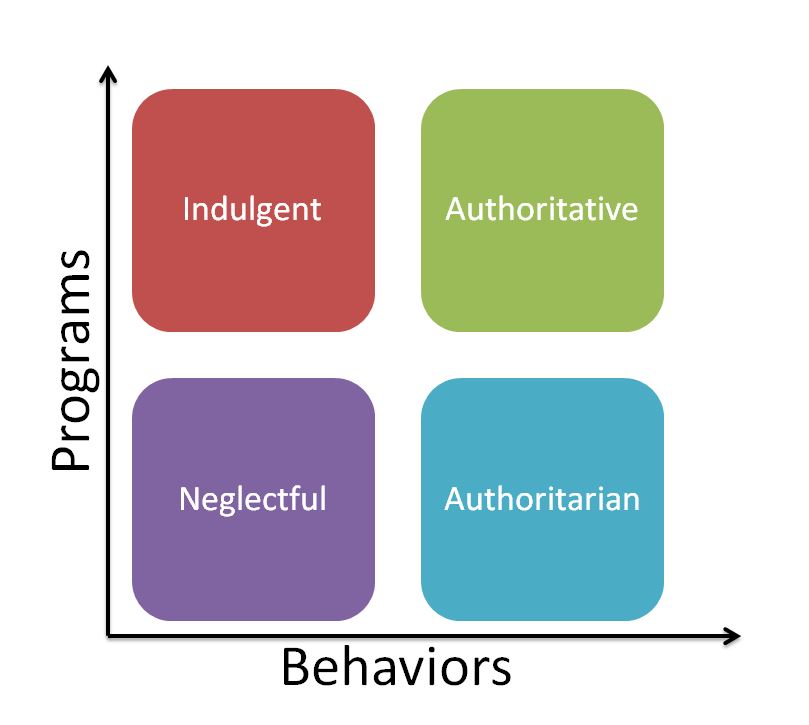
In this post, I am exploring an environment that has both virtually no programs and no behaviors a.k.a Neglectful.

From the parenting aspect, the neglectful category scores the worst of the four in studies. It is also called “hands-off” parenting. “Neglectful parenting can also mean dismissing the children’s emotions and opinions. Parents are emotionally unsupportive of their children, but will still provide their basic needs. Children whose parents are neglectful develop the sense that other aspects of the parents’ lives are more important than they are. Parents, and thus their children, often display contradictory behavior. The parent and the child will never come to an agreement because the child will be resentful and the parent will show a demanding, with great authority side.”

In the safety example of programs vs behaviors, there are many similarities that can be theorized. Certainly, a work place in which there are no safety programs in place and the company and employees show no interest in creating safe behaviors, there is a recipe for disaster. These are companies that have catastrophic losses and extremely high injury rates. Because of the lack of safety systems, there may be many issues that go unreported until they do become catastrophic. In this safety environment when concerns are brought up, there is no concern or follow up. The company may provide basic PPE such as gloves, ear plugs, safety glasses, and locks for lockout tagout. But, there will be a lack of training and the PPE provided will be the most cost effective regardless of effect. Another indicator of a neglectful environment would be where earplugs are on a box fastened to a wall, but there has never been any effort to conduct sound monitoring or create a hearing conservation program. Another indicator of the neglectful environment would be that the PPE is provided, but no one is using it. The programs do not enforce the policy, and the people don’t care enough to try. There is no effort from either side. When there is effort it is short lived and has no follow through or sustainability.

In a similar fashion to the parenting style, the neglectful style is contradictory in many terms. There is never consistency. One day the safety glass policy is the most important event in the company. The next week, they can’t afford safety glasses but everyone needs to be wear ear plugs. The programs come in starts and stops with no sustainability considered for the process.

The greatest issue with this style is very similar to the parenting style: The employees become resentful and the company becomes increasingly authoritative with a heavy handedness for perceived behavioral issues. A good worker (high productivity) may never lockout a piece of equipment, but a perceived poor employee could be fired for an ear plug policy that has never been enforced. In the safety realm, this might also be considered the “flavor-of-the-month” safety program.

Neglectful safety environments are dangerous. There are little to no protections for employees. On the flip side, as a safety professional, I would not have to worry much about working for a neglectful company as they would never hire a safety person. They do not have a desire to change nor do they want to face the harsh reality that the lack of safety systems perpetuate the lack of safety behaviors. I could also theorize that in a neglectful environment quality of product, cost controls, and other basic systems are non-existent. They manage for the short term and hope for long term results. Sometimes in market rich environments, these systems can be sustained simply because the product or service is in high demand.

Overcoming a neglectful environment is difficult. For every year the systems did not exist, it will take 6 months to a year to build them and the culture that comes with it. For example if a safety system has been neglected for 10 years, it will take 5 to 10 years to build it. The key word is “culture.” The programs can be written. The training can be conducted. The critical step is that the company and employees have to keep investing in the programs until it becomes the way of doing business. There will be tests, trials, and revisions. The goal is to maintain the overall course of the change.

The first step is program creation, detailed training, and feedback systems. The focus should be on quick wins and those that gain big wins. A plan, do, check, act process works best with each program. Those programs that help eliminate the biggest risk should be at the top of the list.
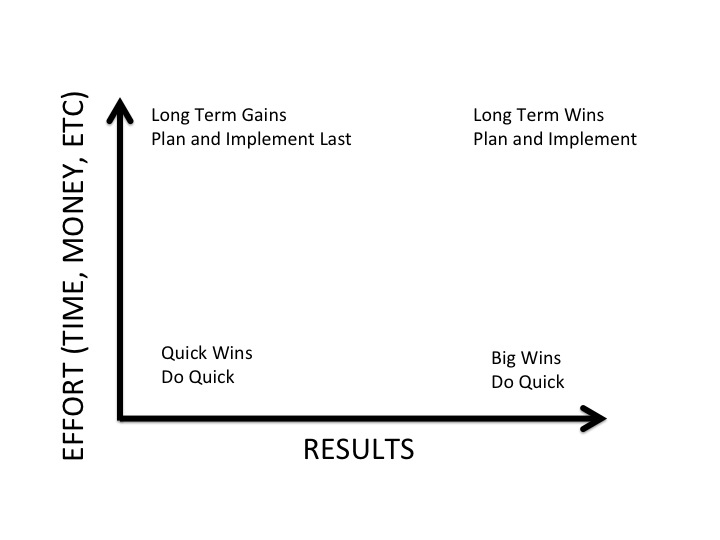
Slide1The view is for the long term. The goal is to create trust in the work force, sustainability in the programs, and long term continuous improvement. It is a long road, but in the end it makes the company better and protects its people. Overcoming a neglectful safety environment can be done, but is has to be done systemically with a view for the long term.

Typologies of Safe Behaviors and Safety Programs – Part 3

So far, I spent two postings just leading up to the actual chart that creates this entire series of posts.

The purpose of these sets of posts is to look at the characteristics of parenting versus safety and how those two are interrelated.

SafetyPgmsBehI will openly admit that I was conducting a one man think tank and proposing the simple of question of “What would an organization look like if they no programs and no safe behaviors and the variances therein?”  As continued thinking through this philosophy off and on, I started to see some real similarities between Maccoby and Martin’s Four Parenting Styles based on Baumrind’s Three Parenting Styles and my four-quadrant system. In the sake of full-disclosure, my mind may have been influenced by just studying that theory and helped in bridging that gap. Either way, I felt there was enough correlation to dig a little deeper.

As a introduction to these ideas, here is a brief overview of the four typologies.

Neglectful = A system where there are no safety programs and no expectations for safe behaviors. The organization is no engaging any aspect of safety or safety management.

Indulgent = A system where there are good programs but no expectations to follow those programs. The system is there, but no one really cares it is there.

Authoritarian = A system where the employees are held extremely accountable but there are no programs or training to empower them in the process.

Authoritative = An organization that has robust training and programs along with holding everyone consistently accountable for their actions.

In part 4, I will take a deeper dive into the Neglectful typology.

Typologies of Safe Behaviors and Safety Programs – Part 2

As discussed in Part 1 of this theme of posts, I started thinking/daydreaming about how to quantify behaviors and programs as they relate to safety. I had previously been interested in the typology of parenting just for personal interest. One morning while making the morning commute, the two began to merge and take some shape. So, I felt the best place to discuss the similarities would be through my blog.

The big question is, “How did I merge these two seemingly unrelated topics?”

One of my biggest pet peeves is the manager that says “safety is just common sense.” It is this thinking that gives the safety profession such a poor name. There are companies that believe that safety is something that is nothing but lip service and common sense. I have a previous post where I really get on that soapbox, so I will spare that rhetoric on this one. The truth is that safety is learned. There is no other way. Even from a early man kind of thought process. There are those that made mistakes that cost them life and limb and then there are those that saw it go bad, made a logical choice to do the same thing, then told others about the problem. I love the history of the chemical elements. It is amazing how the elements were discovered, tested, and utilized. The history of chemistry is rich in safety stories such as these. Early chemists/alchemists used mercury for many experiments and processes. It was through their liberal use, the the rest of the chemical community learned that safety precautions need to be taken in order to prevent going crazy due to the heavy metal building up in the brain. It was the early work, illness, and death of the scientists with the discovery of radionuclides that helped shape safety policy today.

Safety is learned. It is not common sense. It has to be trained and utilized for it to have value for the user.

Another example of how safety is not just common sense relates to hunter safety. Many believe that hunting and fishing are an innate human function that is in correlation to have good real life common sense. The truth is that before someone goes on their first hunting or fishing trip, they are instructed on the safety and methods of the process. Gun safety is of course a number one priority of the education. It also includes, how to protect while in a tree (fall protection), how to field dress the animal (knife use), and moving the animal back to camp. No one is born with this knowledge. It is taught and learned.

The same should be said with any industrial process. Safety is taught and learned. It may seem like common sense for someone who has done it for years, but for others the knowledge is new and unpracticed. A seasoned fortruck operator should know that seat belts are required, how to safely move a load, and how to perform a pre-use inspection. For someone who the process is new to, they need that instruction to help gain that first time information. How would someone know to lockout a machine before maintenance if they had never been instructed? How would someone know how to safely enter a trench if they had never been instructed? It is these same reasons why the statement, “that’s just the way we’ve always done it.” can be so troublesome. Just because that method has seemed to be the right way to do it, does not mean it is. By working toward knowledge and improvement, the safety systems are learned and evolved.

As a parent, I see that it is my job to not instruct my children like a teacher or instructor. It is my job to give them good guidance and information so that they can make good decisions, apply that knowledge, and be safe and successful. If I give my kids lists and lists of dos and don’ts for road safety, they will never take in the essence of the goal of safety. They will use the lists and the one and only method for being safe. If I instruct them to look for the hazards, how to spot the hazards, and the basics of how traffic works; they have a better opportunity to engage that activity with a safety consciousness. Don’t misunderstand, there needs to be hard and fast rules for the road. There also has to be an innate ability to take good information and apply it to a situation to make a good decision. As a parent, there are four typologies that I can fall into based on my style of raising my kids.

When the comparison is made between being a parent and being a safety manager, there are many similarities. Each role is about instructing, improving, and empowering others for safety and success. To me, safety is a life skill that is as important and critical as any other topic. So, the distance to bridge the idea that the four parenting typologies could be used to describe safety is not that large of a gap. They have many similarities especially considering the way that each should be presented. Once we really start diving in to the typologies, the similarities will continue to present themselves, the process will become more apparent, and the overall theme will crystallize. In the next post, I will give an overview and better define of the four parenting typologies.

Typologies of Safe Behaviors and Safety Programs – Part 1

As I was going through a class on child development, a theory really stuck with me in regards to classifying styles of parenting. The theory was Baumrind’s Parenting Typology. I enjoyed and studied the four quadrant version that was expanded by Maccoby and Martin. In this typology, there are four basic parenting types based on: Responsive vs Unresponsive and Demanding vs. Undemanding. So in these cases a parenting style could be Responsive and Demanding or Responsive and Undemanding. The same options are then available for Unresponsive in the same way. This creates four typologies that represent the parenting styles: Indulgent, Neglectful, Authoritative, and Authoritarian. This theory was interesting to me simply because I am a dad, and I wanted to see how I could become a better parent (or maybe just see what my parenting style may ultimately do to my kids).

So . . . how does any of this relate to a safety blog and theory? How did I tie parenting and safety together?

It began with the creation of a training program for leadership behaviors in safety. There appeared that there are two key initiatives in safety: programs and behaviors. There are good behaviors vs poor behaviors and good programs vs poor programs. The in world of safety there can be a combination of each. My thoughts were what would a site look like that had combinations of the variables above. How could those be categorized? How would they function? What were some of the tell-tale signs of the groupings? These thoughts would come and go during my commute. One day it struck me that the four typologies that I was seeking were very similar to those that were listed in the parenting theory. This revelation helped fuel this series of blogs.

The best introduction to the process is to give some definition of behaviors and programs. These are the two items that made me really start thinking about what does a site look like as they have combinations of the two.

Behaviors: Think of this term as how all the employees behave with safety. Are they aware of the work they are doing and how it can be done safely? Do they work in a way that prevents injury? Are they self-correcting items? Do they focus on preventing incidents to themselves and the team?

Programs: This includes the written programs, policies, safety analysis, sampling, auditing, and training. Are the programs written, functional, and understood? Does the team know the policies and how to comply with them? Is the training adequate and regular? Is there investment to revise and improve the programs?

Certainly, there is always room for the gray areas. With good programs, there should be some push for good behaviors.The overall theory is not to look inside each category, but to give an overall macro view of the system. If there was a location that had very strong programs but very poor behaviors, this would create an interesting case study of why this phenomenon would occur. There has to be an underlying meaning to why something at the very top of one category would allow the other to be at the very bottom. It is an interesting thought theory but in practical cases when one improves with deliberate attention, the other should follow with some measure. As you can imagine, behaviors are the hardest to influence positively, takes time to improve, and can erode the quickest. Programs help drive behaviors in both positive and negative ways. There is a causal effect between the two. I am not going to focus on as much about the causes as much as focus on what each category looks like and how those appear in the over arching safety management system.

The focus of the next series of blogs is to better define the four quadrants of this process, and how I correlate those to the parenting typologies. It should be a fun journey.


The Hierarchy of Safety Needs, Part 8

Over the course of eight posts and a few detours along the way, we have explore that safety behaviors can be quantified in a similar fashion as Maslow’s Hierarchy of Needs. There are reasons that are based on basic needs that demonstrate why safety cultures may be moving forward, falling behind, or remaining stationary. There are basic needs that have to be met to allow a safety culture to progress within an organization.

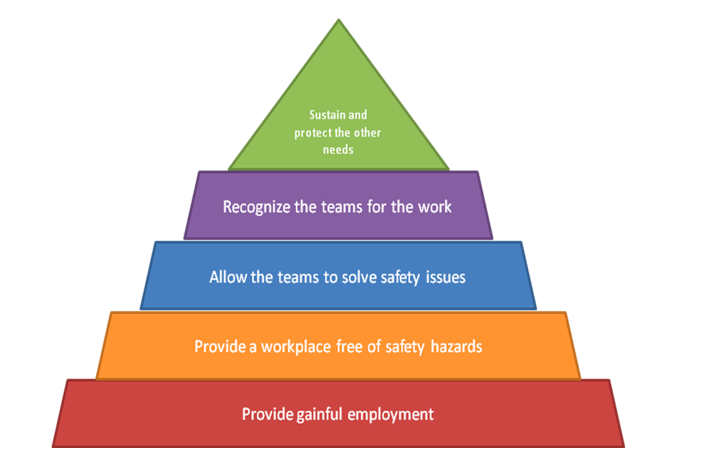
Maslow’s Hierarch of Needs is a good model to predict behaviors based on what need are being fulfilled. When the needs based approach is applied to only the occupational safety area there are many striking similarities. The safety behaviors of a company and be interpreted using a needs based approach. If the needs of the more basic function are not met, the behaviors will mirror and be driven to those needs. A company cannot create a good safety culture without working to assure that the basic needs are met. The most basic, largest, and more energy driven phases of the safety hierarchy are driven primarily by the company management. They have an inherent social contract with the team to first provide gainful employment and to also provide a workplace that is free of serious health and safety hazards. Without the primary needs being met, the company cannot expect safety behaviors to be changed in a meaningful and productive way. As the employees and management fill the lower tier needs and start to shape progressive behaviors, there has to be an acute cognizance of threats to the basic foundation of the pyramid. When threats are encountered, there has to be more effort to mend the foundation or acceptance of the changes in perceptions and behaviors. Overall, the needs based approach to safety delivers insight to why employees may have trouble altering or progressing safe behaviors.

Just as humans have basic needs that have to met for social progression, the world of safety if similar. When considering a company, safety is the most people oriented metric. With that being said, people in groups have social and primal needs that have to met for progression. It cannot be expected that a company can set high expectations without equally empowering their team for success.

In the next series of discussions, I am going to look at the link of programs and behaviors and how those two items can be quantified using a similar typology.

The Hierarchy of Safety Needs, Part 7

The final phase of the needs based process is when the social recognition needs of the team is met. The team becomes almost self-sufficient. They are able to problem solve on their own and find even more creative ways to assure the safety of the site. The teams in this phase are encouraged to take over entire safety based program from writing the policy to performing the training. The team is driving and self-sustaining the gains. The management’s job is to clear and roadblocks and to help assess the progress. The progress is sustained through assuring that the previous behavioral needs are met. As demonstrated earlier when a lower segment of the pyramid starts to erode, the behaviors will revert to attempt to fill the more fundamental and basic need. This process builds to a true system of continuous improvement in the safety system. The team is finding ways on its own to seek out and correct issues before they happen. The gains that the safety teams have made are well sustained and ingrained in the culture. There becomes a total sense of ownership in safety. This is a tough phase as it is about letting go of the programs and truly empowering the team to make safety about the team and culture. It is critical during this phase, that the lower needs are reviewed regularly to assure that they are being met. It gains will not be sustained if: The business itself cannot be sustained, the safety items fail to get fixed, or the teams are not given time and resources to do a proper job. Gained this level of the a team based safety approach is about investing the team and investing in the individuals. This is truly a phase where break-through behavioral growth is over, and the focus in more on continuous improvement and total system sustainment. The goal is to not assume that the journey is over. The journey is always continuing. The focus will shift to auditing the process and looking for ways that improvements can be created. It is the process that has to maintained. The process drives the strong results.

The Hierarchy of Safety Needs, Part 6

This is part 6 to a series of posts based on Maslow’s Hierarchy of Needs. The theory takes that same basic premiss of having a progression of needs based behaviors and applying them to how safety progresses in an occupational environment.

This phase of the pyramid is a focus on progressing the teams and having the teams watch for safety issues for each other. It is important to note that the progression to this phase is marked by having an effective safety program that creates a strong sense of safety in the individuals in the organization.

The change from team work to recognition is slight from a mechanical approach, but dramatic from a behavioral aspect. The teams are no longer reliant on management for the solutions. The teams are finding and implementing solutions on their own. The resources are available and accessible. The teams know how to correct, report, and follow up on any safety concerns that are arising. They have the support of management through financing, resources, and attention. The supervisory responsibilities would include following up on work to assure corrections were complete and assuring the team stays focused on the tasks they begin. The most important aspect that has to be fulfilled is the need for recognition. The environment has to recognize these teams individually and publicly for their accomplishments. Their need has grown beyond simple social interaction, but now the desire to be appreciated is apparent. The company should take time to recognize and reward the work of their committees. The goal is to fulfill the need to be recognized.

This phase is marked with behaviors that are looking for the next safety improvement. The team knows that the company is committed to correcting and improving the safety of the site. The teams are now on the look of any predictive measures and items to correct to assure that injuries and incidents are prevented.

The teams are conducting self assessments for behaviors and conditions that can lead to safety issues. They are not worried of offending or judging others. The primary focus is helping each other to be safer. They coach each other and share success across the organization. If one department find a creative solution to correct a safety condition, that practice is carried to other departments. The key factor is to seek ways for the team to improve various aspects of the safety program.

The Hierarchy of Safety Needs, Part 5

So far, we have discussed the inherent process of having a job, creating a safety culture, and creating a team culture. At this point, it would make sense to have a simple validation process of understanding needs based safety.

A reverse logic approach can be applied as part of a validation of the behaviors. If a company has a functional safety committee with good participation and ideas, then it can be implied that the company has fulfilled the obligation to provide a workplace that is perceived to be free from serious hazards. This process does not take the place of a strong physical hazard auditing system, but it gives indication of the culture, behaviors, and perceptions that are present among the members of the workplace. With all the behavioral tiers of the pyramid the same reverse logic can be applied to the needs below. If employees feel safe, then there is a perception of employment stability as is seen with workers’ compensation when layoffs are a potential. Safety can be affected when gainful employment is at risk. The lowest filled need is the one that behaviors gravitate toward. The perceptions drive the behaviors, as the behaviors are driven by a fundamental needs based approach as theorized originally by Maslow.

The Hierarchy of Safety Needs, Part 4

To recap the needs based safety theory so far: 1) Safety is a needs based behavior 2) Before an organization can progress to the next need, the previous one has to be fully realized 3) The process is: Gainful Employment, Personal Safety, Team Work, Recognition, Continuous Improvement. 4) The previous posts have: discussed the theory and promoted personal safety. This post is in regards to creating a team based safety culture.


This phase is marked by a behavior that is more inherently concerned with the “we” rather than the “me.” The individual first has to feel personally safe before he can look to his team member and have concern for them also. In this phase of the behaviors approach, safety committees can start to realize their full potential. The lower needs have been fulfilled, and the individuals can start to become more socially aware of safety. The goals are for the groups to begin to identify issues and work together to avoid injury. The social process of safety is simply an approach that is broadened beyond the individual. It will be a process of where the work group will share safety items, be aware of hazards to the group, and work together to improve the environment. The goal is to encourage the teams to self-develop and empower them to solve problems along with progressing safety.

A key management behavior in this phase is to conduct technical training. This is so the teams understand the safety regulations and programs the implement those laws. For the team to be effective, they have to understand the end of goal of not only meeting but exceeding the safety regulations. They cannot be expected to accomplish this task without some technical training on the relevant regulations. The team will also need some training on what it means to be a functional team. This would include fostering team work, listening skills, and facilitation workshops. The team has to function singly with and have the interpersonal skills to support one another.

A critical component of this phase is open and honest communication between the company and the committees. It is the company’s responsibility to assure that the committees understand the constraints of the business. The scope of the work has to be set to that items such as time, resources, and money are defined. There is no reality of having unlimited of any of those three. On the other hand, it is the company’s responsibility to assure that those items that can be corrected are accepted with the utmost importance. Quick wins should be implemented with speed and longer projects should be tracked with milestones being publicized. The two way street of implementation and communication between the company and the employees start to emerge, grow, and take on life. Overall, this is a phase where team work among the individuals and between the company and employees starts to bloom.

HeirarchyDescription

DOL Report on Injury Inequality, Part 2

To continue thoughts on the DOL report on how workers’ compensation creates inequality in workers.

This report is getting quite a bit of attention from various media sources and confirms some of the same items that reports from both PBS and NPR have investigated.

The report goes through a number of ways that the lack of worker safety along with a potentially failing workers’ compensation system can create a disparity among injured workers. The report is summarized very simply as the best approach to workers’ compensation is to prevent worker injuries. If a worker does not get hurt, a workers does not need work comp. The report is put together well, but there are a number of ways OSHA is not as effective as it could be in creating momentum for worker safety.

First, OSHA has an amazing amount of red tape before a new law can be propagated. Do we have a comprehensive combustible dust standard? No. Do we have an ergonomics standard? No. Are the PELs for chemicals inclusive and up to date? No. Is the injury and illness prevention plan (I2P2) ready for use? No. Too many times a safety professional’s hands are tied due to the lack of comprehensive legislation. I was speaking to a fellow regulatory professional one day, and he relayed the story of a manager who felt that OSHA was the “Cadillac” of the safety world. Amazing, right? OSHA is the law. It is the bare minimum standard. OSHA still relies heavily on the general duty clause which has too much room for interpretation.

Second, OSHA is understaffed and inconsistent. What prevents someone from speeding? The idea that there could be a cop around the bend that will catch and fine you for it. Without sufficient coverage of compliance officers, there are businesses that can operate with minimal fear of the local OSHA office. Certainly, OSHA comes to visit when there are significant injuries (see the updates to the reporting law) or complaints. The key factor, though, is that a company has to be honest with the law. If an organization has made the choice to not follow the law, why would they choose to inform their employees of their rights or report correctly when warranted. Certainly, there are very stiff penalties if caught for willfully under reporting. Overall, the best way to catch problems is to have people in the field finding them. Please forgive the oversimplified analogy: If the police want to stop speeding, they do not create a self reporting hotline for speeders.

Third, in my experience, OSHA compliance officers are inconsistent. I have had some really good compliance officers that evaluate my processes and programs find they are functional and move on. I have also had some visit who did nothing but write citations for anything and everything. It was like an egg on the wall theory. Smack it against the wall and see how much sticks. There has got to be consistency in the process. If a compliance officer is judged effective through sheer number of citations, then they will write more citations. What gets measured, gets done. Just to be clear, though, if there is a true violation; it should be cited clearly and consistently. I can accept tough regulations as long as they are enforced consistently. The problem comes with the grey areas of the law or the lack of legal understanding.

Which leads me to my fourth point, the regulations are not user friendly. In someways, I find that perfectly acceptable as companies need people like me to help them comply. On the other hand, it is not easy to find a clear answer to questions. When speaking in terms of worker safety, the topics are not only a broad array but in-depth. When researching a standard, there are many considerations. What does the regulation say? Are there interpretations to read? What was the intent when the law was written? How did public comment change it? Are the references such as NFPA, ANSI, etc.? How has recent citations affected the interpretations of the law? Are there state specific laws? It takes time to implement a process right just in understanding alone.

Worker injuries are devastating. They should be prevented. But, there is more that can be done from an OSHA standpoint to help that accountability, education, and simplification.